

The Evolutionary Leap of Aerospace Intelligent Manufacturing: The Path of AI Empowerment from "Experience-Based" to "Data-Driven" Decision Making(Part Ⅰ)
Standing at the dawn of 2026, the global manufacturing sector is undergoing an unprecedented reconfiguration of its cognitive and operational frameworks. The aerospace industry, long the benchmark for precision engineering and uncompromising quality—now stands at the epicenter of this transformative wave. Aerospace Industrial Development Corporation (AIDC), a leader in the aerospace sector, is actively promoting its AIxWARE smart manufacturing services. This initiative provides a deep analysis of how the aerospace industry is transitioning from a traditional reliance on the "tacit knowledge" of seasoned craftsmen to a data-driven approach, moving further toward an era of autonomous execution powered by Agentic AI.
This article examines the structural challenges faced by aerospace manufacturing under a high-mix, low-volume production model and illustrates how artificial intelligence technologies can address critical issues such as supply chain disruptions, workforce discontinuity, and quality traceability. It places particular emphasis on how the Model Context Protocol (MCP) functions as a neural network connecting heterogeneous equipment across manufacturing environments, and how Generative AI applications - such as "Ask AIDC" - transforms unstructured knowledge into real-time productivity. Amid growing geopolitical dynamics driving the global shift de-risked and non–China-centric supply chains," unmanned aerial vehicles (UAVs) have emerged as a new engine of growth for Taiwan’s aerospace industry. As the Chair of the "Taiwan Excellence Drone Industry Business Opportunity Alliance (TEDIBOA)," AIDC utilizes AI smart manufacturing technology to support domestic UAV startups in overcoming the barrier to scaled mass production.
Finally, we look ahead to the next 5 to 10 years, identifying opportunities for Taiwan’s machine tool and aerospace industries amidst the twin waves of Software-Defined Manufacturing and Environmental, Social, and Governance (ESG) transformation.
Current Status and Structural Pain Points of Aerospace Manufacturing in 2025
In 2025, the Aerospace and Defense (A&D) industry have entered a phase of accelerated growth following the completion of post-pandemic supply chain restructuring. However, this growth is not characterized by linear capacity expansion. Instead, it represents a stress test of manufacturing resilience under the combined pressures of geopolitical friction, shifts in workforce structures, and paradigm changes in technology. For Taiwan’s machine tool industry and aerospace supply chain, understanding these structural challenges is critical to securing orders and maintaining competitiveness over the next decade.
The Double Squeeze of High-Mix, Low-Volume and Certification Barriers
What fundamentally distinguishes aerospace manufacturing from the automotive or consumer electronics industries is its uncompromising safety standards and it high-mix, low-volume production characteristics. A single aircraft is composed of millions of individual components, yet the annual demand for a specific part may be limited to only a few dozen units. This production reality results in frequent line changeovers, high tooling costs, and extremely low tolerance for error.
The Digitization Crisis of Master Craftsman Expertise
For decades, the stability of aerospace manufacturing has relied heavily on the "feel" and intuition of senior technicians—often referred to as tribal knowledge. For instance, in the autoclave process for composite materials, experienced craftsmen are able to anticipate temperature variations among within the chamber and manually adjust parameters to prevent costly scrap, drawing solely on years of hands-on experience. However, as the baby boomer generation reaches retirement, this form of tacit knowledge is rapidly eroding. Today, aerospace manufacturing can no longer rely on non-replicable individual experience. Instead, such expertise must be transformed into digital assets that can be learned by algorithms and readily retrieved by the next generation of workers.
The Rigid Requirements of Nadcap and AS9100
The entry ticket to the aerospace industry consists of rigorous certifications. Standards such as Nadcap (for special processes) demand not only procedural compliance and correct outcomes, but also full traceability of process parameters - including temperature, pressure, and cycle time. For segments of supply chain, traditional practices such as manual record-keeping or fragmented data logs are no longer sufficient to meets the growing expectations of international OEMs for real-time transparency. To remain qualified, the supplier must prove that its production processes are under strict digital monitoring and that they possess proactive early-warning capabilities to detect and mitigate risks before nonconformities occur.
Supply Chain Fragmentation and the Silo Effect
Although Taiwan’s aerospace industry has established a relatively complete "A-Team 4.0" supply chain ecosystem, many small and medium-size enterprises (SMEs) remain digitally fragmented. Factories are filled with controllers (e.g., Fanuc, Siemens, Heidenhain, Mitsubishi) of different brands and vintages, all speaking different languages with incompatible data formats. This heterogeneity has given rise to Data Silos, resulting in several structural challenges:
- Lack of Equipment Transparency: Management teams are unable to gain real-time visibility into the actual operating status of machines - whether they are actively cutting, idling or merely warm-up.
- Weak Quality Traceability: When defects occur in finished products, it is difficult to trace them back to the corresponding machining parameters or tool conditions.
- Barriers to Cross-Facility Collaboration: Central plants cannot accurately monitor the capacity utilization and material status across satellite factories in real-time, leading to unreliable lead-time forecasts.
The Role Transformation of the Machine Tool Industry: From "Selling Hardware" to "Selling Intelligence"
For Taiwan’s machine tool manufacturers, market demand in 2025 has undergone a fundamental shift. Aerospace customers are no longer just purchase solely high-rigidity, high-precision hardware; they require Cyber-Physical Systems (CPS) with cognitive capabilities. Future machine tools must possess the following traits:
- Self-Awareness: Capable of actively monitoring spindle vibrations, thermal displacement, and tool wear.
- Adaptability: Able to adjust feed rates in real-time based on sensor feedback to protect high-value workpieces, such as titanium alloy impellers.
- Connectivity: Natively supporting standards such as Model Context Protocol (MCP) or OPC UA, enabling seamless integration with the customer's operational command center.
Implementing the AIxWARE System: Transitioning from Experience-Based to Data-Driven Decision Making
As a leading aerospace company in Taiwan, AIDC recognizes that the aforementioned pain points cannot be resolved simply by purchasing off-the-shelf software. Therefore, we developed the AIxWARE smart manufacturing solution—not merely a software suite, but a digital platform for codifying aerospace manufacturing domain expertise. The core philosophy of AIxWARE is: "Every piece of data can inform a decision; every task is assisted by AI."
AIxWARE System Architecture and Ecosystem
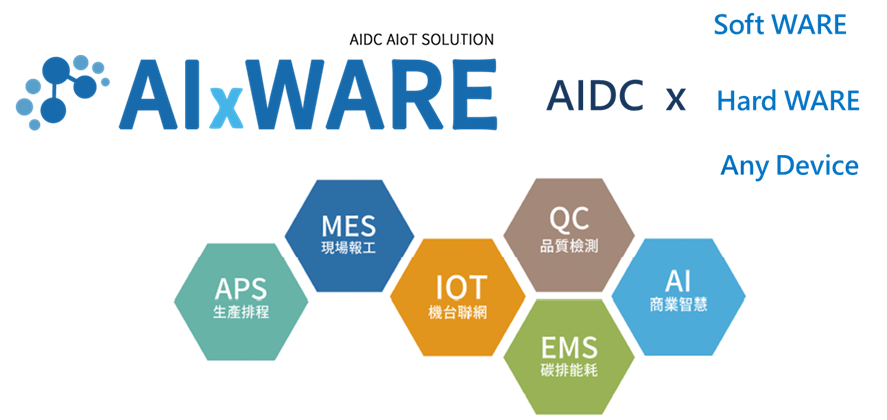
The core concept of AIxWARE can be summarized as AIDC x (Software + Hardware + Any Device). It is designed to address traditional manufacturing challenges, including aging machinery, cross-brand management difficulties, and digital silos. Its architecture comprises the following key modules:
- Heterogeneous System Integration Module: This module breaks down the data barriers between ERP (Enterprise Resource Planning), MES (Manufacturing Execution System), and PLM (Product Lifecycle Management), enabling a seamless flow of work orders, materials, and process information.
- IoT Device Connectivity Module: By utilizing direct controller integration or external sensors, this module captures low-level physical data, including electrical current, vibration, temperature, and flow rate.
- AI Application Module: This module includes specialized functions such as defect detection, equipment health monitoring (PHM), production scheduling optimization, parameter tuning and generative AI assistants.
 |
Deep Dive: Deploying Generative AI in Aerospace Manufacturing — "Ask AIDC"
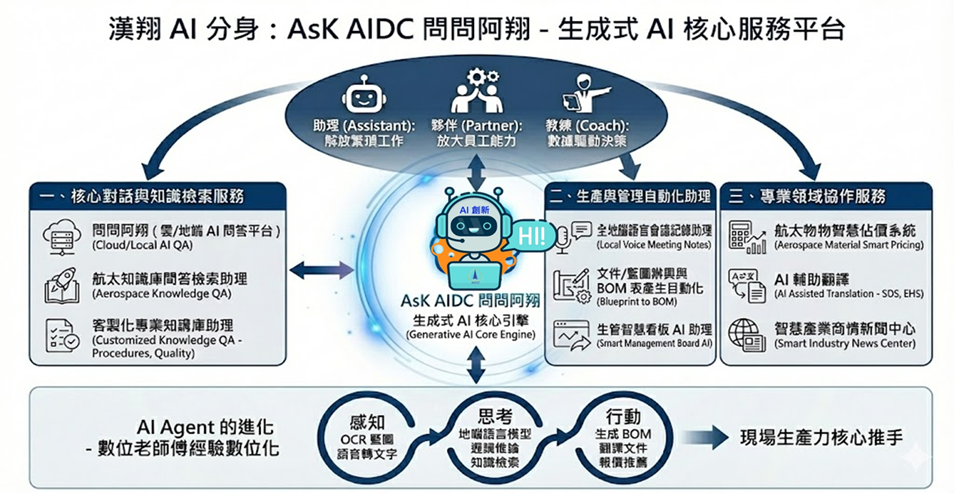
By 2026, Generative AI has evolved from a Chabot toy into a digital foreman on the factory floor. AIDC’s "Ask AIDC" serves as a paradigm for the practical deployment of Large Language Models (LLMs) in the aerospace domain.
Navigating the "Sea of Data"
The aerospace industry generates an extensive volume of technical documentation, including Boeing and Airbus specifications, maintenance technical orders, standard operating procedures (SOPs), and decades of failure case reports. In the past, engineers facing a problem would often spend hours reviewing documents or consulting senior colleagues.
Ask AIDC utilizes Retrieval-Augmented Generation (RAG) technology to establish a private corporate knowledge base (vector database), converting all technical documents into vector embeddings. When an employee asks, "How do I troubleshoot an overcurrent alarm on the Z-axis of a 5-axis machine?" the system does not generate answer arbitrarily. Instead, it first retrieves relevant chapters from maintenance manuals and historical repair records from the internal knowledge base. The AI then generates an accurate, verifiable response, complete with links to the original documents.
AI-Assisted Quoting and BOM Generation
In the aerospace Original Equipment Manufacturer (OEM) business, the speed of quotation often determines whether a contract is won. Customers typically provide hundreds of pages of PDF blueprints or unstructured requirement documents.
- Pain Points: Manually deconstructing drawings, identifying part specifications, querying material prices, and estimating labor hours often takes several days and is prone to human error (such as missing items or misinterpreting specifications).
- AI Solution: Ask AIDC integrates OCR (Optical Character Recognition) for data preprocessing with Natural Language Processing (NLP). It scans PDF drawings, identifies part numbers, materials, dimensional tolerances, and textual descriptions within tables to automatically generate a structured BOM (Bill of Materials). The system then cross-references historical cost data from the ERP system with current raw material market prices to calculate estimated costs and generate suggested quotes through a decision-making model.
- Performance: Empirical tests show that AI-assisted preparation for a single component's quote has been streamlined from 9 steps and 20 minutes to 3 steps and 2 minutes, resulting in nearly a 10-fold increase in efficiency and significantly mitigating the risk of miscalculation. The impact is even more pronounced when applied to complex aircraft section quotations.
 |
Guardians of Machine Health: AI Predictive Maintenance and Thermal Compensation
Precision is the lifeline of aerospace manufacturing. AIxWARE demonstrates how data can be transformed into physical accuracy.
Machine Health Monitoring
Traditional maintenance follows a time-based or reactive approach - "replace when due" or "repair when broken". AIxWARE, however, establishes a machine health profile by monitoring spindles and feed axis current signatures and vibration spectra.
- Case Study: During a casing machining operation, the system detected a subtle, abnormal spikes in the Z-axis motor current waveform, which had no triggered any controller alarm. The AI model recognized this pattern as highly similar to previous instances of insufficient ball screw lubrication and immediately issued a yellow alert. On-site inspection confirmed a blocked lubrication channel, preventing potential spindle seizure and the scrapping of high-value workpieces. This "red-yellow-green" visual management system makes otherwise invisible machine issues immediately apparent, enabling proactive intervention.
Intelligent Thermal Compensation
Metalworking machines experience thermal displacement caused by motor heating and ambient temperature changes during prolonged operation – critical for aerospace components with micrometer-level (µm) tolerances.
- Traditional Approach: Operators spend 1–2 hours each morning performing warm-up cycles to reach thermal equilibrium, a process that consumes substantial energy and reduces production capacity.
- AI Solution: Temperature sensors are installed at key machine locations (e.g., columns, spindle heads) and utilizing laser interferometers measure actual displacement. The AI model learns the non-linear relationship between temperature and displacement, enabling the controller to dynamically compensates axis positions in real-time data.
- Benefits: Warm-up time is drastically reduced or eliminated, machining precision is improved, and energy consumption is significantly lowered by minimizing idle operation.


