

The Next Frontier for Overseas Expansion: Taiwan’s Machine Tool Industry in the U.S., Japan, and Europe
Global supply chain realignment, geopolitical shifts, and the upgrading of end-user manufacturing are creating a new wave of overseas expansion opportunities for the machine tool industry. In recent years, the United States, Japan, and Europe have emerged as key markets for Taiwanese machine tool companies. For Taiwanese businesses, the reindustrialization efforts in the U.S. and the European Union, together with the accelerated move toward China-free supply chains, are opening rare market opportunities. Japan, with its deep technological foundation in machine tools, also offers possibilities for Taiwanese companies to enhance their global competitiveness through strategic alliances, joint ventures, or mergers and acquisitions.
Whether overseas expansion succeeds depends not only on market strategy and business judgment. For Taiwanese companies with extensive market experience, these are often not the greatest challenges. The real difficulty lies in execution. From market selection and corporate structuring to tax planning, customs arrangements, and labor compliance, every step involves different legal systems and administrative procedures. Without thorough planning and clear division of responsibilities, even a sound strategic direction may fail to translate into effective implementation, leading to cost overruns, schedule delays, or even missed business opportunities.
This article presents three cases of Taiwanese companies expanding into the U.S., Japan, and EU markets, combining practical observations with tax-related reminders for companies considering similar overseas moves.
Case 1: Establishing a U.S. Presence Without Prior Planning for Cost Structure and Tax Burden
A Taiwanese machine tool company had long developed the U.S. market through an export-based model. As customers began demanding faster delivery and real-time technical support, the company decided to establish a subsidiary in the U.S., lease a warehouse, and set up a technical center to strengthen local service capabilities and increase order opportunities. At the time, the company mainly assessed incorporation costs, rent, and initial hiring expenses, assuming that business growth would gradually recover the investment.
Once operations began, problems soon emerged. In recent years, the U.S. has tightened work visa policies for foreign nationals and significantly increased application fees, making it increasingly difficult to build a team model centered on Taiwanese expatriates after setting up a U.S. entity. If the company turns instead to local recruitment, labor costs are far higher than originally estimated. In addition to base salaries, employers must bear social security tax, Medicare tax, unemployment insurance, health insurance, retirement contributions, and other expenses. Given the significant differences between U.S. labor regulations and those in Asia, total personnel costs often reach 1.3 to 1.5 times the base salary. Insurance, equipment maintenance, and local taxes for warehouses and technical centers were also higher than expected, challenging management’s original assumptions about profitability in the U.S.
This case shows that Taiwanese companies expanding overseas often underestimate the operating pressure of high-cost countries. Companies usually focus on tax rates, incorporation fees, facility or office costs, and annual maintenance expenses such as finance, visa matters, and tax filing that are easy to ask about. However, they often fail to allocate sufficient budget for a complete review of visible and hidden costs across the operating process, as well as compliance requirements beyond basic tax and accounting matters. This can seriously distort cost expectations and cause companies to overlook the need for stronger market-entry strategies and process optimization in high-cost environments.
Case 2: The First Lesson Before Investing in Japan: Cultural Understanding and Compliance Preparation
Japan is a mature market with a well-established legal system. Its geographic proximity to Taiwan and close business ties have long made it an important overseas investment option for Taiwanese companies. Before investing in Japan, however, companies should not only assess market size, cost structure, and tax burden, but also understand Japanese corporate culture and visa rules for personnel dispatched to provide services in Japan. Otherwise, communication gaps or compliance oversights may affect the investment timeline.
First, Taiwanese companies should recognize the difference between Japanese and Taiwanese decision-making cultures. Japanese companies tend to adopt a cautious consensus-based approach. Major cooperation projects usually require cross-departmental consultation, repeated information confirmation, and step-by-step written approvals under internal procedures. Compared with some Taiwanese companies that emphasize speed and flexibility, Japanese companies place greater emphasis on collective consensus, risk control, and long-term trust. Taiwanese companies discussing investment, cooperation, or supply chain arrangements with Japanese counterparts should therefore not expect final decisions within a short period, but should instead allow sufficient time for communication and decision-making.
Taiwanese companies often also experience differences in culture and service models when working with Japanese professional institutions. Taking Japanese tax accountants who assist with tax filings as an example, in a relatively conservative professional environment, they usually avoid offering “best practice” recommendations or planning-oriented advice. Instead, they explain the relevant tax rules in response to specific questions raised by the company. For Taiwanese companies accustomed to relying on external professionals to make judgments, this approach may be perceived as insufficiently proactive. At a deeper level, however, it also reflects the need for companies to strengthen their own independent judgment regarding overseas compliance information.
In terms of personnel arrangements, Taiwanese companies often mistakenly assume that because Taiwan and Japan allow 90-day visa-free stays, staff can be dispatched directly to work in Japan. In fact, short-term stays generally apply only to activities such as market research, customer visits, factory tours, trade show visits, office site discussions, or meetings with lawyers, accountants, administrative scriveners, and other professionals. During such stays, individuals may not engage in paid work or actual business operations in Japan. If personnel provide services within Japan and receive salaries, bonuses, service fees, or other consideration, they must in principle first obtain a status of residence that permits work.
Case 3: Without EU Tax and Logistics Planning, Sites in Poland and Czechia May Face Compliance Risks
Although the European Union is a single economic area composed of multiple sovereign countries and seeks consistency in fiscal and economic rules such as taxation, in practice, intra-EU transactions and distribution may still involve multi-country reporting mechanisms and tax authority procedures. Consider a Taiwanese company setting up a site in Poland to supply customers in Germany and Czechia. In the early stages of cross-border operations, business or logistics teams often take the lead, with distribution efficiency as the main decision-making factor. If tax, customs, and document management arrangements are not reviewed at the same time before the site is established, the company may face delayed import VAT refunds, additional tax payments on cross-border sales, or even customs audits after operations begin.
Logistics routes should therefore not be designed solely based on transportation efficiency or cost minimization. They should be planned together with the tax and customs structure. When designing a European distribution model, companies should confirm whether the customs clearance location, warehousing location, final delivery destination, invoicing process, and transaction documents are consistent. They should also assess import VAT treatment, intra-EU goods supply reporting, the possibility of VAT registration in the destination country, customs clearance costs, and delivery requirements under different routes. Relevant internal departments and external advisors should participate jointly to balance operational efficiency with compliance requirements.
For Taiwanese companies planning to use Poland, Czechia, or other Central and Eastern European countries as EU operating bases, an overall compliance framework assessment should be completed before establishing a site. Tax planning, logistics design, customs document management, and the applicability of EU simplification mechanisms should all be included in the decision-making process. Through advance planning and ongoing review, companies can reduce tax and customs risks while improving supply chain predictability and customer service quality. In other words, compliance planning is not only a legal risk management tool, but also a foundation for Taiwanese companies to build long-term operational resilience and competitiveness in the EU market.
These cases show that Taiwanese companies expanding into high-cost, high-margin markets such as the United States, Japan, and Europe require a level of analytical depth and strategic planning that differs greatly from past approaches in cost-oriented, production-for-export markets such as mainland China or ASEAN. Operating costs in advanced markets are higher, and any underestimation of costs or misjudgment of regulations may cause overall expenditures to spiral out of control. Companies must therefore rely on highly localized professional assessments rather than informal information gathered from industry peers. In addition, if an overseas site is established merely to complete an existing service model or serve existing customers, the benefits may not be sufficient to offset the added costs. Companies should also optimize their service models, identify and cultivate emerging local markets and customers, and develop pioneering business strategies and action plans. This will be the key to whether an investment project shifts from difficult maintenance to proactive growth.
For Taiwan’s machine tool industry, which is mainly composed of small and medium-sized enterprises, however, it is undoubtedly challenging for individual companies to complete the above analysis and form a comprehensive market strategy with limited manpower, resources, and budgets. As a result, overseas expansion through a coordinated “team approach” has become an important consideration for many Taiwanese manufacturers. This approach is not simply a matter of gathering several companies to act independently. It requires organization, mechanisms, resource integration, and the ability to promote strategic actions that a single SME would find difficult to execute alone, so that genuine synergies can be created.
The models that have gradually taken shape in the semiconductor supply chain in recent years—such as overseas expansion through holding companies, group collaboration, and platform-based initiatives—offer useful reference points. For example, TechXin Holding was jointly invested in by eight semiconductor front-end process-related companies, including Gudeng Precision, All Ring Tech, Gallant Precision Machining, Microprogram, Calitech, TOPCO Scientific, Foxsemicon, and others, enabling them to share resources and coordinate strategic actions through a holding platform. Other supply chain partners have followed major customers overseas, using Taiwan’s existing high-efficiency cluster model to establish localized support ecosystems abroad. Some have also used platforms such as the Taiwan New Eastbound Alliance for Global Industry, Academia and Research Cooperation to advocate collectively and share business opportunities. How Taiwan’s machine tool industry can integrate resources and build a coordinated overseas expansion system suited to its own characteristics deserves joint consideration by the industry.
Conclusion
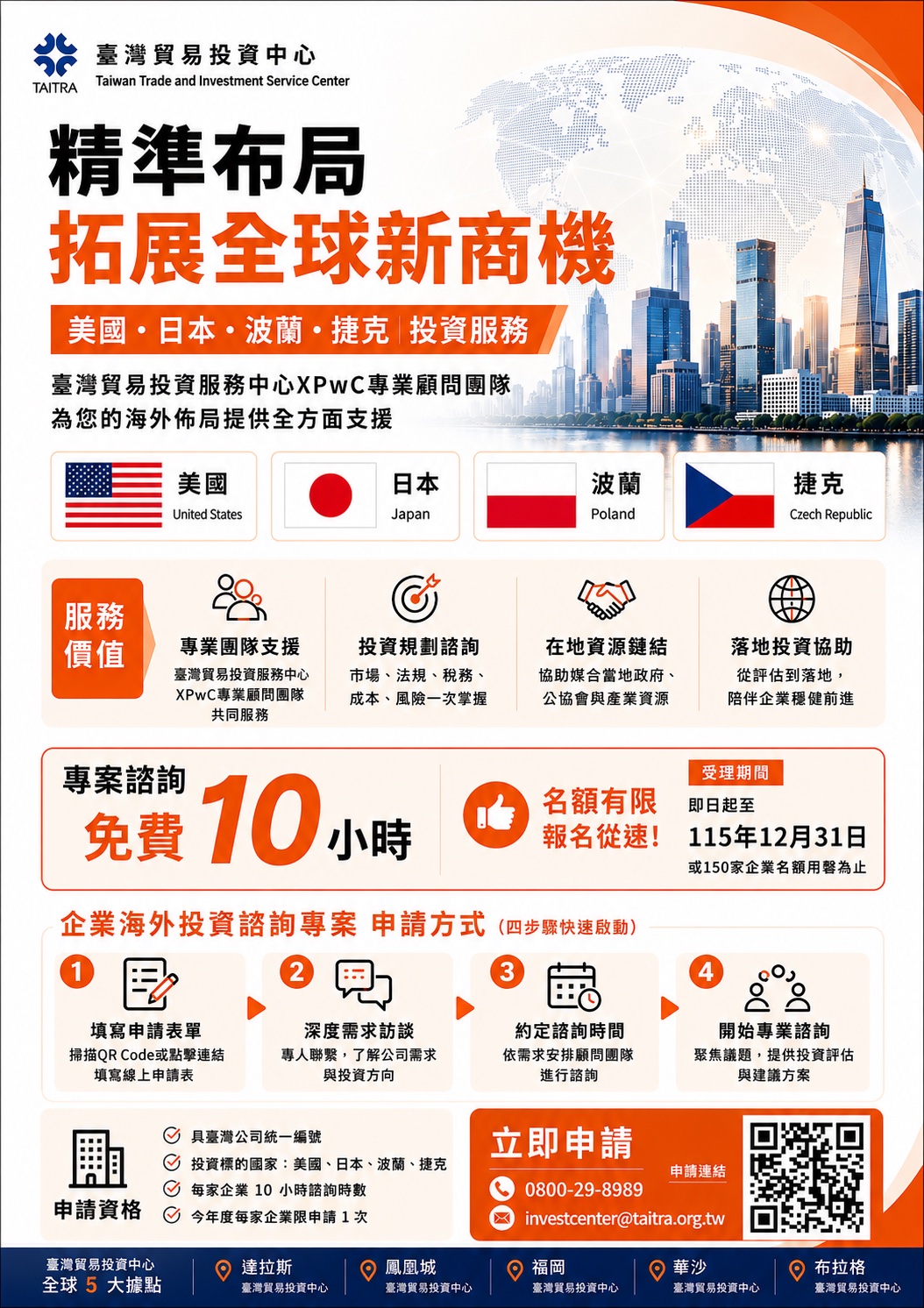
Making good use of government advisory resources can help companies overcome overseas compliance and cultural barriers. Under the guidance of the International Trade Administration, Ministry of Economic Affairs, the Taiwan External Trade Development Council (TAITRA) has established Taiwan Trade and Investment Centers in Dallas and Phoenix in the United States, Fukuoka in Japan, and Warsaw and Prague in Central and Eastern Europe. These centers provide local consultation, matchmaking, and support services for Taiwanese companies. Their value lies not only in providing information, but also in helping companies quickly understand local business environments, connect with government and industry resources, shorten the trial-and-error process, and develop market-oriented sales strategies and supply chain diversification with limited resources.
These investment centers also work with tax expert teams from international professional organizations to provide application guidance, one-on-one compliance assistance, and investment landing consultation for companies. Through one-stop services covering local market intelligence and regulatory compliance, a comprehensive overseas investment advisory ecosystem can be formed, helping companies move from concept to implementation and from implementation to expansion, while reducing trial-and-error costs and improving success rates.
The machine tool industry is facing a reshuffling of the international market landscape. The United States, Japan, Poland, and Czechia each represent different opportunities, including high-end demand, technological validation, European supply chain positioning, and regional manufacturing hubs. If Taiwanese companies can combine product strengths with strategic thinking and apply precise investment model design together with rigorous tax and compliance planning, they will have the opportunity to build deeper competitive barriers in overseas markets. In doing so, they can drive simultaneous upgrades in corporate capabilities, supply chains, and service models, creating a sustainable engine for international growth.
 |


