

Toward Transparent Global Supply Chains: Insights from Digital Product Passports and the ESPR
International Markets Are Moving from Product Performance to Lifecycle Transparency
As net-zero transition and circular economy policies gain momentum, international market expectations are moving beyond product performance, price, and delivery time. Increasingly, companies are being asked to provide lifecycle information that is clear, reliable, and verifiable. For Taiwan’s export-oriented industries, future competitiveness will depend not only on meeting safety, quality, and functional requirements, but also on the ability to explain a product’s material composition, repairability, recycled content, recycling pathways, and whether such information can be accessed by consumers, supply chain partners, customs authorities, and regulators. In this context, the Digital Product Passport (DPP) is emerging as a key instrument for building transparent global supply chains.
The ESPR and DPP Are Reshaping EU Market Access Rules
The EU’s Ecodesign for Sustainable Products Regulation (ESPR) is the most representative framework of this shift. Entering into force in 2024, the ESPR goes far beyond traditional energy-efficiency requirements. It expands ecodesign into a broader system of lifecycle management, covering durability, repairability, upgradability, reusability, recyclability, hazardous substance control, energy and resource efficiency, recycled content, and product information disclosure. In essence, the EU aims to use product design and information transparency to reduce premature obsolescence and increase the potential for repair, refurbishment, remanufacturing, and high-quality recycling.
The ESPR will not apply to every product category at once. Instead, the EU will introduce delegated acts for specific product groups in phases, defining the scope of application, ecodesign requirements, information to be disclosed, data granularity, access rights, and technical specifications. In principle, products covered by these future requirements will need a Digital Product Passport before they can be placed on the EU market. The DPP is therefore more than an environmental label. It is likely to become a regulatory foundation linked to market access, customs controls, and product compliance management.
The Digital Product Passport Becomes a Common Interface for Compliance, Traceability, and Supervision
Chapter III of the ESPR sets out the core provisions for the Digital Product Passport, mainly in Articles 9 to 15. These provisions cover requirements for regulated products to carry a product passport; unique identifiers for products, economic operators, and facilities; data carriers attached to the product, its packaging, or accompanying documents; and open, interoperable, machine-readable, and searchable data formats. They also address the reliability, completeness, and security of product passport data. The EU will establish a product passport registry and web portal connected to the customs single window system. As a result, product information will no longer serve only as consumer guidance. It will also become part of regulatory inspection, border management, and market surveillance.
Importantly, the DPP concept is not limited to the ESPR. The EU Batteries Regulation already requires certain battery products to introduce a battery passport and disclose information such as carbon footprint, material composition, and recycled content. The battery passport must also be interoperable with the ESPR product passport in communication, data transmission, semantics, and organization. The Critical Raw Materials Act (CRMA) further requires information disclosure for certain products containing permanent magnets, including whether a product contains permanent magnets, as well as their type, weight, location, chemical composition, and instructions for safe removal. This information must be linked through a data carrier to a unique product identifier. Together, these rules show that the DPP is gradually becoming a common interface through which the EU integrates product compliance, resource circulation, and supply chain traceability across different regulatory fields.
Annex III of the ESPR further indicates the breadth of product passport data, covering product identification, operator information, use and safety information, compliance and technical documentation, traceability, and system management information. Where required under other EU legislation, the DPP may also include declarations of conformity, technical files, or certificates of conformity. This suggests that conformity management, represented today by CE marking, may become increasingly connected with digitalized product data. A similar trend can be seen in recycled content disclosure. Whether for recycled metals under the Batteries Regulation or emerging requirements in packaging, construction materials, textiles, vehicles, and other sectors, credible, verifiable, and exchangeable data will be essential. The DPP can therefore be understood as a digital container for carrying and exchanging such information.
Taiwan’s Regulatory Framework Is Aligning with Product Information Disclosure and Traceability Trends
Taiwan is also building regulatory and pilot foundations in response to this international trend. Following the recent enactment of the Resource Circulation Promotion Act, Article 22 introduced provisions on product information disclosure and labeling. It authorizes the central competent authority to designate certain articles, packaging, or containers and require manufacturers, importers, or sellers to disclose information within specified timeframes and by specified methods. This information may include material composition, the ratio of recycled pellets or materials, packaging material and weight, repairability, durability, repair methods, and methods for recycling, dismantling, and reuse. If a unique product identifier is used, information on flow traceability and quality verification should also be dynamically updated. Although the provision may not explicitly use the term “Digital Product Passport,” it already reflects the core ideas of product identification, information disclosure, dynamic updating, and traceability verification.
 |
Even before the legislation was finalized, the Resource Circulation Administration under Taiwan’s Ministry of Environment launched a Digital Product Passport pilot program in 2023. Using product categories such as notebook computers, batteries, mobile phones, tablets, and textiles, the program tested data fields, permission management, batch import, front-end inquiry, and business registration processes. Its purpose was not only to establish a platform prototype, but also to help domestic industries become familiar with the operational model of digitalizing, standardizing, and continuously maintaining product information before international requirements expand further, thereby reducing future adjustment costs.
ISO 59040 Provides a Foundation for Circular Economy Data Exchange
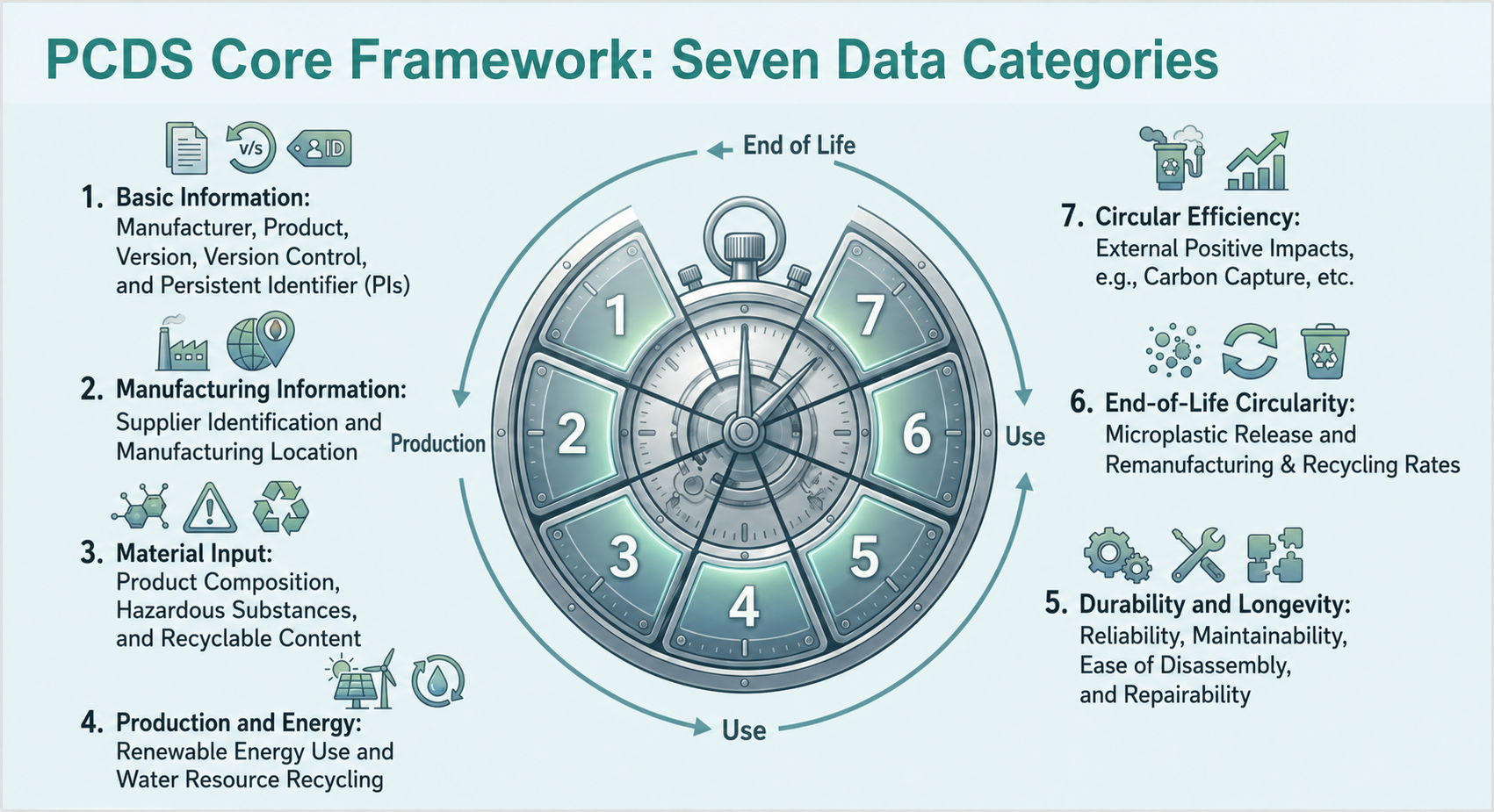
On the standards front, ISO 59040, the Product Circularity Data Sheet (PCDS), provides another important reference point. The purpose of ISO 59040 is to enable suppliers and buyers to exchange product circularity information in a standardized format without disclosing unnecessary trade secrets. Its data categories include template information, company and product information, material input, circular production, durability and life extension, post-use circulation, and circular benefits. A key feature is that it reduces the reporting burden while preserving transparency and verifiability through yes-or-no questions, range-based data, and links to supporting evidence. For companies, the PCDS can serve as an entry point for building the data foundation of a DPP, helping convert information scattered across procurement, design, production, quality assurance, maintenance, and sustainability functions into a more consistent and exchangeable format.
 |
The Machine Tool Industry Should Build Supply Chain Trust through Data Governance
For the machine tool and components industry, this trend should not be viewed simply as another reporting requirement. It should be seen as part of a broader shift toward industrial digitalization and supply chain upgrading. Machine tools have long service lives, contain numerous components, depend heavily on maintenance and after-sales service, and are often embedded in complex cross-border supply chains. If international customers begin requesting information on product lifecycle, parts origin, material composition, energy consumption, maintenance, refurbishment, or recycling, the ability to respond quickly and accurately will directly influence a company’s position in the supply chain.
Machine tool companies do not need to build a DPP system from scratch. A practical starting point is to review the data already available in ERP, PLM, MES, BOM, quality assurance, maintenance service, carbon management, and supplier management systems, and identify which data correspond to product identification, material composition, key components, maintenance, energy efficiency, recycled content, restricted substances, and recycling treatment. The next step is to establish a unique identification logic for products and components, enabling machines, modules, key parts, and maintenance records to be connected. Companies should also plan data classification and permission management, distinguishing among publicly available information, supply chain collaboration information, regulatory inspection information, and trade secrets, so that transparency does not create unnecessary business confidentiality risks. Finally, they should introduce machine-readable formats and standard interfaces, such as APIs, JSON-LD, or other interoperable data formats, to support future connections with customers, platforms, and regulatory systems.
At its core, the Digital Product Passport is not about centralizing all corporate data and handing it over to governments or platforms. Rather, it encourages companies to build their own data governance capabilities. Enterprises remain responsible for data creation, maintenance, updating, quality control, and information security, while governments and markets obtain the compliance and supervisory information they need through regulations, standards, identification mechanisms, permission management, and API specifications. Seen from this perspective, the DPP is also a step toward becoming AI-ready. As product and supply chain data become more standardized, structured, and machine-readable, they will support not only regulatory compliance, but also automated compliance checks, after-sales service, predictive maintenance, circular business models, and supply chain risk management.
From Documentation to Data: Entering the Era of Transparent Supply Chains
In short, the ESPR, the Batteries Regulation, the CRMA, recycled content disclosure requirements, and ISO 59040 all point to the same direction: product information is moving from documents to data, and from passive disclosure to information that is searchable, verifiable, and exchangeable. For Taiwan’s machine tool industry, early investment in product data governance is not only a response to EU regulations. It is also a critical foundation for strengthening international supply chain trust, enhancing service value, and developing circular business models.


