

AI Enablement in the Machine Tool Industry: Case Studies and Enterprise AI Governance
AI Adoption and Transformation Trends in the Machine Tool Industry
Global manufacturing is entering a new era of smart manufacturing driven by artificial intelligence. As the foundation of industry, the machine tool sector is rapidly expanding its competitive focus beyond traditional precision mechanical structures, machine rigidity, and control accuracy into new frontiers of hardware–software integration and intelligent enablement. Practical assessments conducted under the Machine Tool Industry AI Empowerment Mark promoted by the Taiwan Machine Tool & Accessory Builders’ Association (TMBA) indicate that Taiwanese machine tool and component manufacturers have progressed beyond early proof-of-concept (POC) initiatives and entered a substantive implementation phase characterized by enterprise-wide process integration and AI capabilities embedded directly in products and machines.
However, as AI moves from laboratories to factory floors and customer sites worldwide, the industry faces major challenges, including model drift, insufficient validation using real cutting data, cybersecurity and data-sovereignty risks, and the absence of standardized AI governance procedures. This paper consolidates corporate cases from the second AI Empowerment Mark program, presents a de-identified technology map, and combines practical observations with a concrete analysis of opportunities, key considerations, and an enterprise AI-governance transformation framework aligned with ISO/IEC 42001 and the EU Artificial Intelligence Act (EU AI Act).
Machine Tool AI Application Case Map
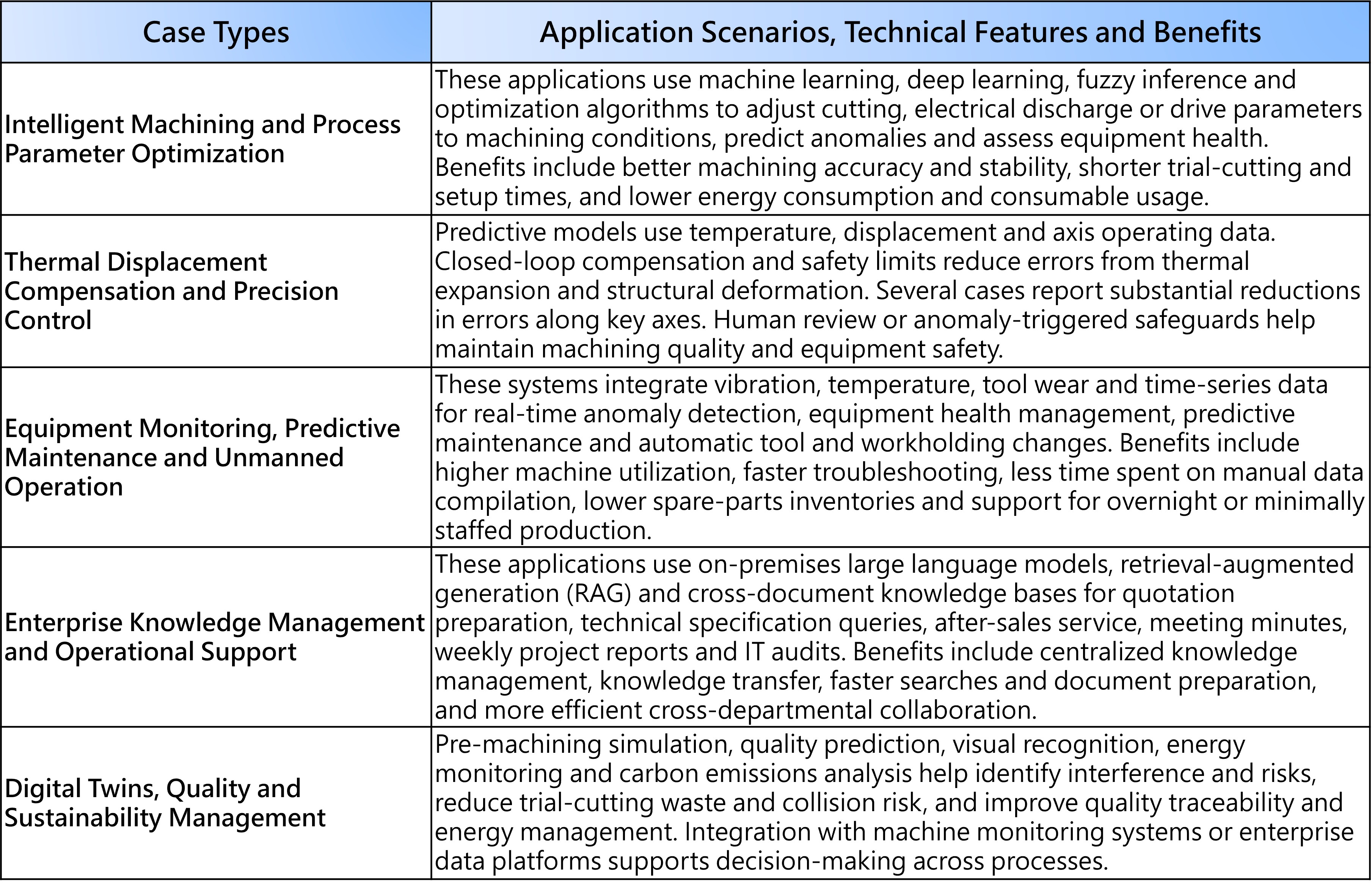
The second Machine Tool Industry AI Empowerment Mark assessment covered entries in both the Enterprise AI Empowerment category (Category A) and the Product AI Empowerment category (Category B). To objectively examine the industry’s overall technological maturity and quantified benefits, this paper reorganizes representative entrants’ cases in de-identified form, as shown in Table 1. The table demonstrates the diversity and specificity of AI adoption in Taiwan’s machine tool industry. Both internal operational optimization—such as quotation preparation, drawing recognition, and inventory control—and enhancement of machine value—such as thermal compensation, chatter suppression, and predictive maintenance—have produced impressive, quantitatively verified benefits.
 |
Classification of Core AI Technologies and Statistical Analysis of Ap6plications
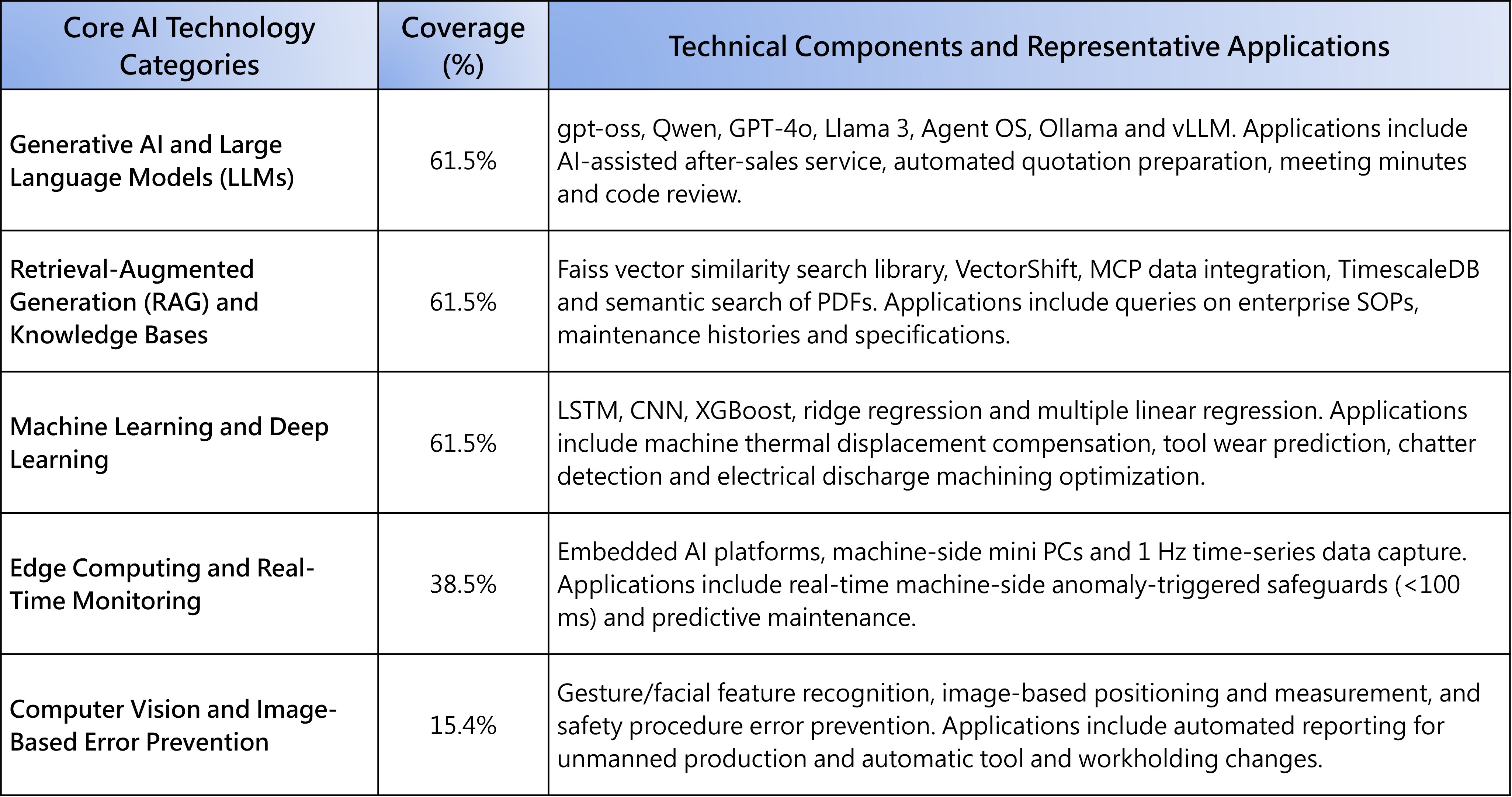
A technical review of the representative enterprise cases above identifies five core categories of AI technology currently used in the machine tool industry. Because most manufacturers adopt cross-domain “hybrid AI architectures”—for example, combining large language models with edge-computing sensors—the aggregate coverage across categories exceeds 100%, as shown in Table 2. The results indicate that LLMs (large language models), RAG (retrieval-augmented generation), and conventional ML/DL (machine learning/deep learning) are tied for first place, each with a coverage rate of 61.5%. This clearly confirms a dual-track pattern in the industry’s AI transformation: operations rely on LLM+RAG to process unstructured knowledge, while machine-side applications rely on ML/DL to process structured physical sensor data.
 |
Practical Observations: Opportunities and Key Considerations for AI Adoption in the Machine Tool Industry
The assessment observations reveal that Taiwan’s machine tool industry has demonstrated strong innovative momentum amid the AI transformation, while also exposing several deep-seated technical and operational concerns.
Transformation Opportunities: Business Model Innovation, KaaS Knowledge Monetization, and Global 24/7 Intelligent Services
- Transitioning from one-time equipment sales to Equipment-as-a-Service (PaaS/SaaS): Traditional machine tool businesses depend on one-off hardware sales and are therefore vulnerable to economic cycles. Participating companies have begun to package AI capabilities—such as thermal compensation, predictive maintenance, and forming-process monitoring—as software modules for internal pricing or subscription-based operation, creating stable, long-term software revenue streams.
- Productization and secondary monetization of industry knowledge bases (KaaS): Machine tool manufacturers have accumulated decades of machining know-how across aerospace, automotive, medical, and semiconductor applications. By using RAG vectorization to encapsulate this tacit expertise in industry-specific knowledge bases—Knowledge-as-a-Service—the knowledge can support internal transfer, be sold as high-value software bundled with machinery, or even be supplied to end customers for independent deployment and expansion.
- 24/7 intelligent service across time zones and language barriers: Taiwan’s machine tool industry is highly export-oriented. Participating companies have combined on-premises multilingual LLMs with maintenance histories to create online AI service experts, reducing the time required for initial complaint diagnosis and technical-document searches by 80%–90% and helping address insufficient maintenance capacity among overseas distributors.
- Digital twins for fewer machining defects and greater energy efficiency: Participating companies use integrated virtual–physical digital-twin simulations before machining to predict cutting forces and toolpath interference before trial cutting. This substantially reduces trial-cut waste and collision risk while supporting green, low-carbon manufacturing.
Four Major Challenges in Real-World AI Deployment
- Challenge 1: Model Drift and the Absence of Dynamic Retraining Mechanisms
Most manufacturers have yet to establish adequate post-deployment validation mechanisms for AI applications, whether internal apps or machine-side models. They generally cannot clearly explain how model drift will be monitored, when optimization should be triggered, or how optimization will be performed. Current practice typically involves developing a solution in the factory, packaging it, and shipping it as a one-time deployment. Commercial confidentiality concerns often prevent remote connectivity for collecting customer-site data and iteratively upgrading models through online retraining. Consequently, the accuracy of AI modules may decline significantly after a period of operation.
- Challenge 2: Validation Through Actual Cutting Versus Static Estimation
At present, validation of AI-enhanced machine functions often remains limited to idle or cold-machine conditions, data-based estimates, or theoretical simulations. Few cases provide rigorous comparative data from fully warmed machines and actual metal cutting. For example, many manufacturers substantiate energy-saving claims solely with pre-machining digital-twin simulations or lack clearly defined ISO 14955 measurement boundaries under cold- and warm-machine operating conditions. As a result, claimed AI benefits may be difficult to reproduce at customer sites.
- Challenge 3: Cybersecurity, Data Sovereignty, and Risks in Underlying Model Architectures
The assessment found that some participating companies use open-source AI frameworks and models such as Dify or Qwen to develop AI systems. Although these tools are accessible and relatively inexpensive, their use with highly sensitive machine tool technologies, customer machining drawings, corporate knowledge bases, Chinese-language semantics, and specialized terminology raises concerns involving data privacy, information security, and corporate AI sovereignty. These concerns may become significant cybersecurity barriers when companies seek entry into high-end European and North American supply chains.
- Challenge 4: Noise in RAG Semantic Retrieval and Semantic Management of Knowledge Bases
As internal knowledge bases grow increasingly complex, many manufacturers directly combine all documents for RAG vectorization. During human–machine interaction, this makes AI chatbots prone to retrieving redundant or weakly related information and may even produce severe hallucinations. The assessment found that only a small number of leading participants understood how to compartmentalize data by organizational function—production, sales, human resources, R&D, and finance—or by product line, thereby enabling AI systems to precisely narrow the retrieval scope.
Enterprise AI Governance Framework: Alignment with ISO/IEC 42001 and the EU AI Act
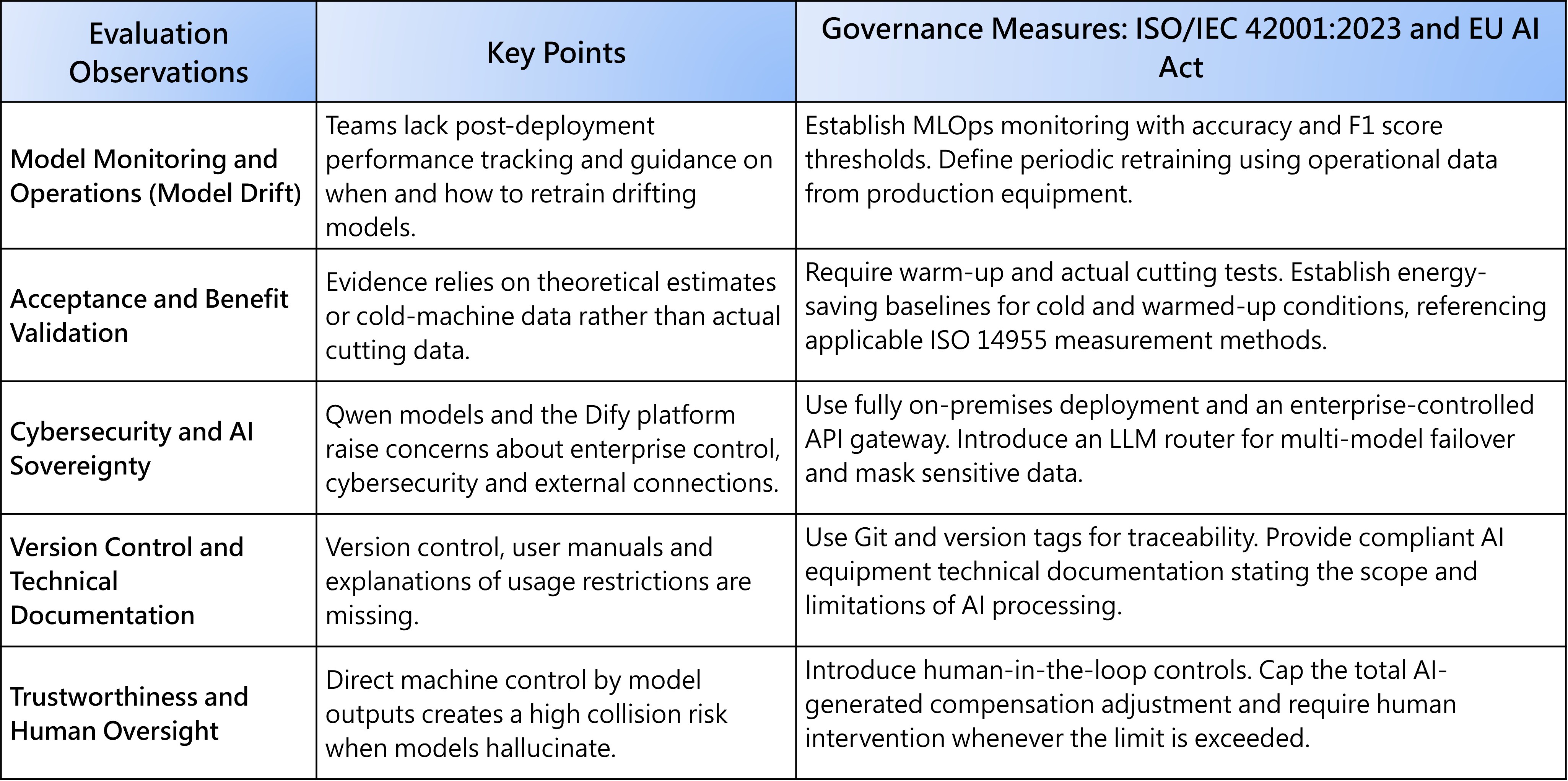
To address the practical concerns above, Taiwan’s machine tool industry should advance from voluntarily encouraged AI experimentation to standardized, enterprise-level AI governance. In alignment with the international AI management-system standard ISO/IEC 42001 and the EU Artificial Intelligence Act (EU AI Act), machine tool companies should establish the governance response matrix presented in Table 3:
 |
1. Strategy and Budget: From Individual Encouragement to Formal AI Strategy and Policy
Clearly defined AI program budgets and management procedures are not yet widespread; most initiatives focus only on encouraging employees to use LLMs. Drawing on ISO/IEC 42001, senior management can establish a cross-functional AI governance committee, allocate a dedicated annual AI budget, and define transparent KPI review procedures.
2. Trustworthy AI and Human-in-the-Loop Safety Controls
Some leading cases appropriately evaluate AI outcomes using trustworthy-AI principles such as fairness, transparency, reliability, and explainability. More importantly, companies should implement Human-in-the-Loop controls. When an AI-generated thermal-compensation value or control parameter exceeds a defined safety threshold—such as the maximum total compensation—the system must automatically block the action and require operator review, thereby preventing machine collisions caused by model hallucinations or abnormal inputs.
3. MLOps Version Control and Preparation of an “AI Equipment Technical Manual”
To meet EU AI Act requirements applicable to the import of high-risk industrial equipment, machine tool manufacturers should provide an “AI Equipment Technical Manual” with each shipment. The manual should clearly disclose: (1) the AI model’s training dataset and boundary conditions; (2) applicable machining materials and limitations of use; and (3) the model version number (Git version tag) and maintenance and update requirements. This can substantially reduce the common implementation gap in which a POC succeeds but deployment at the customer site fails.
4. LLM Router, Multi-Model Redundancy, and Layered Data Compartmentalization
Drawing on mature architectures demonstrated by participating companies, enterprises may establish an LLM router and multi-model orchestration gateway. This enables flexible switching between on-premises open-source models and advanced cloud models according to query context, cost, and cybersecurity level, while avoiding vendor lock-in. At the same time, enterprise data should be vectorized and compartmentalized by production, sales, human resources, R&D, and finance to prevent RAG systems from retrieving irrelevant noise.
Conclusion and Recommendations
Overall, these observations show that Taiwan’s machine tool industry has achieved clear progress from proof of concept toward operational integration, intelligent equipment, and service-model innovation. The next stage of competitiveness will depend not only on algorithmic performance, but also on the ability to establish governance capabilities that are verifiable, traceable, maintainable, and compliant with international requirements. Such capabilities will enable AI benefits to be reproduced consistently in real-world environments and converted into long-term market trust and business value.
1. Priority Recommendations for Governance and Implementation
- Establish an institutionalized AI governance framework: With reference to ISO/IEC 42001 and international regulatory requirements, clearly define responsibilities, budgets, risk classification, data use, intellectual-property management, and performance-review mechanisms. Cross-functional collaboration should ensure that governance requirements are implemented throughout R&D, operations, and the product life cycle.
- Strengthen model life-cycle management and evidence-based acceptance testing: Implement MLOps/LLMOps monitoring, version traceability, performance-drift detection, and retraining procedures. For product-side applications, consider comparative testing under warm-machine conditions, actual cutting operations, and varied operating scenarios to establish repeatable and comparable performance benchmarks.
- Address cybersecurity, data sovereignty, and operational safety together: Select on-premises, private-cloud, or controlled-cloud architectures according to data sensitivity, and implement access controls, data masking, multi-model redundancy, and audit logs. Where machine control is involved, consider Human-in-the-Loop controls, safety limits, and abnormal-condition blocking mechanisms.
2. Recommendations for Industry Collaboration and Market Alignment
- Develop common industry guidelines and documentation frameworks (templates), including AI equipment technical documentation, risk disclosures, version maintenance, acceptance methods, and supply-chain cybersecurity requirements. These resources can reduce the cost of independent exploration by individual companies and increase confidence among international customers.
- Promote shared testing resources and benchmarking methods: Subject to safeguards for confidentiality, ownership, and lawful use, develop de-identified corpora, representative operating conditions, test datasets, and performance-evaluation processes. These resources can help companies of different sizes compare solutions, validate results, and shorten implementation cycles.
- Continue developing capabilities in governance, auditing, and cross-domain integration. Through demonstration sites, supply-chain collaboration, and alignment with international standards, support the evolution of AI applications from isolated POCs into scalable, maintainable intelligent operating models that create sustainable value.


