

Bipedal Humanoid Robots and the Next Growth Frontier for Taiwan’s Precision Machinery Industry
Abstract
Embodied AI is moving humanoid robots beyond demonstration prototypes and toward real factory applications. Their commercial success will depend not only on AI capabilities, but also on whether their joints can deliver high power density, precision, rigidity, impact resistance, low energy consumption, and scalable manufacturability. Linear actuators, rotary actuators, and dexterous hands together account for more than 70% of motion-system costs. Behind these subsystems are planetary roller screws, ball screws, harmonic and planetary reducers, motors, bearings, and precision machining—areas in which Taiwan’s machine tool industry has accumulated strong capabilities. This article examines the performance and cost bottlenecks facing humanoid robots, and explores how machine tool builders, component suppliers, and automation equipment providers can move beyond individual part processing toward joint-module co-development, process equipment, and mass-production validation to capture the next wave of high-value manufacturing opportunities.
Introduction: After the AI Wave, Manufacturing Capability Becomes the Decisive Factor
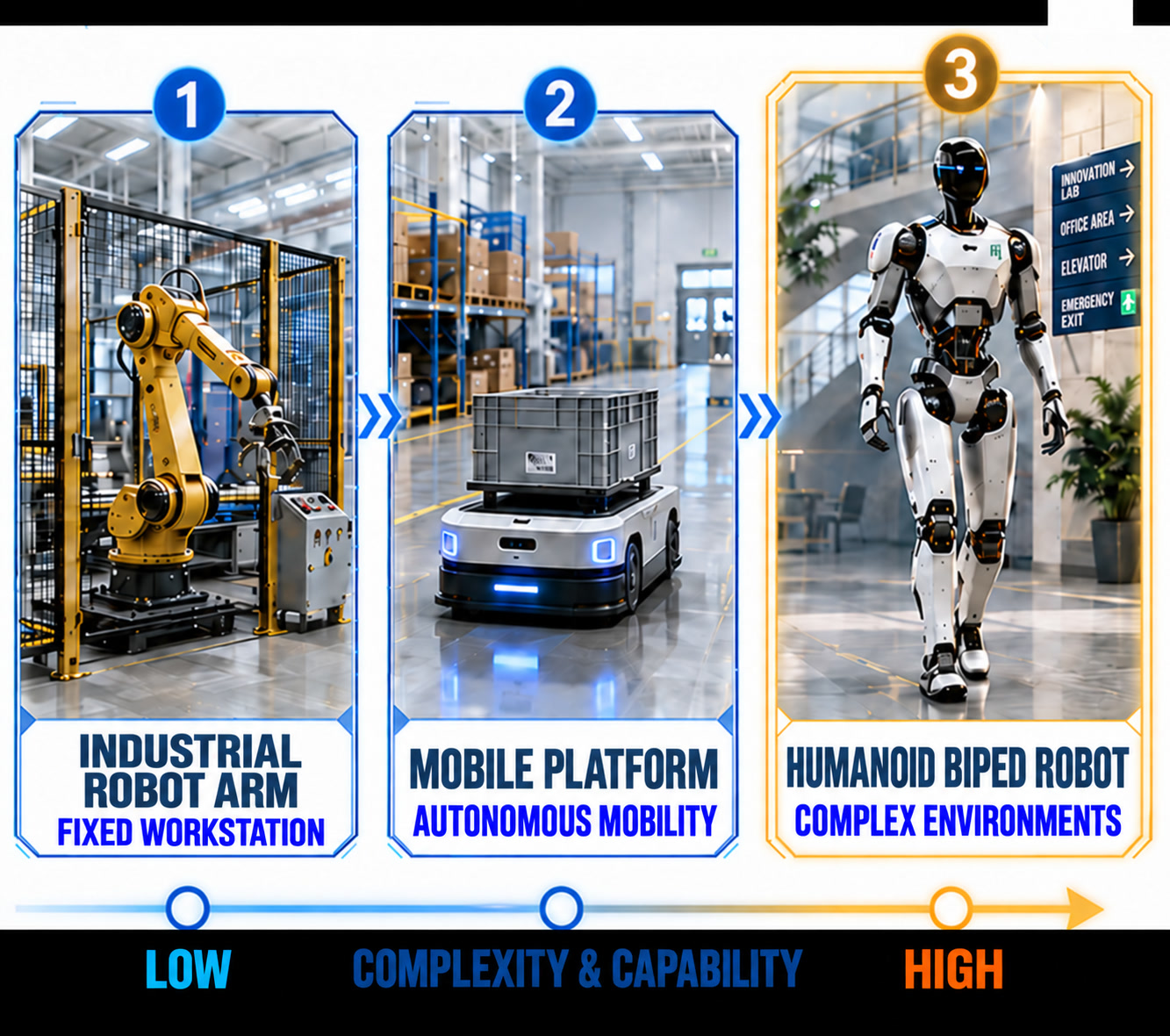
Robotics technology is evolving from fixed-position operation to mobile deployment, and now toward autonomous work in complex environments, as shown in Figure 1. Early industrial robots were mainly installed at fixed workstations, where they delivered high precision and repeatability. Later, AGVs and AMRs enabled robots to move autonomously across flat factory floors. Today, bipedal humanoid robots are being developed to navigate stairs, thresholds, and uneven surfaces, extending robotic activity from structured production lines into spaces that more closely resemble human living and working environments. Because existing factories, tools, and workflows are largely designed around the human body, humanoid robots may be able to support handling, loading and unloading, inspection, and cross-station operations without requiring major changes to the surrounding environment.
 |
Source:PMC (2026)
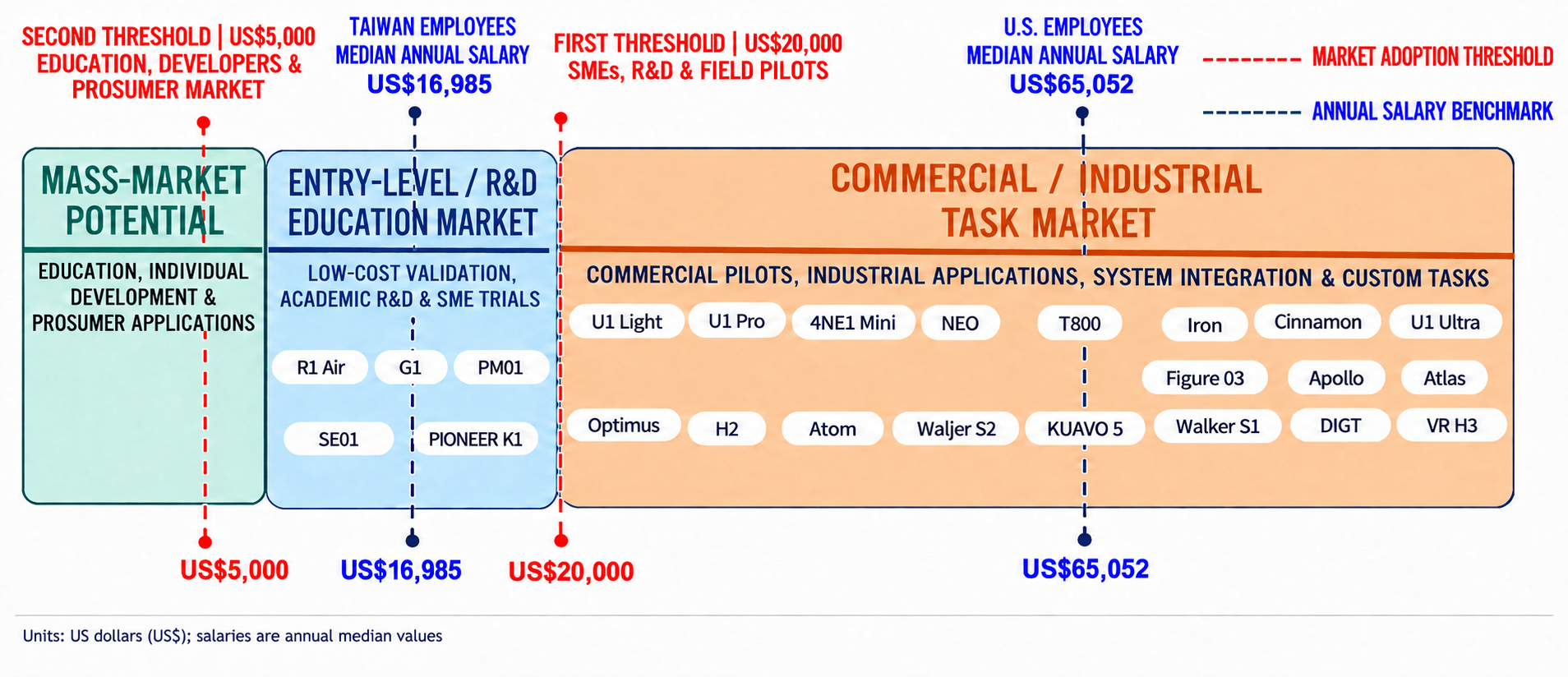
Market forecasts also point to the growth potential of bipedal designs. Based on Global Market Insights data referenced in Figure 2, the global humanoid robot market could approach USD 200 billion by 2035. The market for bipedal humanoid robots is projected to surpass wheeled humanoid robots in 2028 and become the dominant product category by 2030. From 2026 to 2035, bipedal humanoid robots are expected to post a compound annual growth rate of 43.9% and account for about 47% of the overall humanoid robot market by 2035. In addition to technological progress, falling product prices will be a key driver of market expansion. As shown in Figure 3, products currently priced above USD 20,000 are mainly concentrated in industrial applications, commercial pilots, system services, and customized tasks. Once prices fall below USD 20,000, adoption may expand among SMEs, research institutions, and educational organizations. If prices move closer to USD 5,000, the market could further extend into personal development, education, and quasi-consumer applications. The median annual wages of employees in Taiwan and the United States shown in the figure are used mainly to compare relative purchasing power across markets, rather than to define thresholds for product adoption. Overall, the lower the price, the broader the potential application base; however, real market scale will still depend on functionality, reliability, safety, maintenance costs, and return on investment.
Yet market forecasts and successful demonstrations do not automatically translate into commercial deployment. In real-world operating environments, ground impacts, changes in friction, transmission backlash, structural deformation, heat buildup, and sensing latency can magnify small simulation errors into joint vibration, loss of balance, or even a complete robot fall. As a result, competition in humanoid robots is shifting from “how intelligent the AI model is” to a new stage defined by “how reliable the electromechanical hardware is, and whether it can be manufactured at scale and at cost.”
For Taiwan’s precision machinery industry, humanoid robots are not a distant emerging product. They are mobile precision machines composed of dozens of high-performance actuated joints, sensing components, and control systems. Their requirements in materials, precision machining, screws and reduction drives, motor control, assembly inspection, and automated mass production closely overlap with the machine tool and precision machinery capabilities Taiwan has built over many years. Turning these existing manufacturing strengths into high-performance, low-cost, and verifiable key components and joint modules will be critical for Taiwan to capture the next wave of opportunities in the humanoid robot industry.
/MA%E5%9C%962.-ENG.jpg) |
 |
Source:Institute for Information Industry (2026)
The Largest Cost Item—and the Opportunity Closest to the Machine Tool Industry
According to Bank of America research, the early bill of materials (BOM) for a humanoid robot is approximately USD 90,000 to USD 100,000 per unit. With scale and standardization, this figure could fall below USD 17,000 by 2030. Among the major cost items, linear actuators account for about 27%, rotary actuators for about 24%, and dexterous hands for about 19%. Together, these motion-related mechanisms represent more than 70% of total cost, as shown in Figure 4. In other words, the main battleground for mass-production cost reduction is not outer-shell assembly, but the design and manufacturing of screws, reducers, motors, bearings, sensors, drives, and joint housings.
Joint configurations vary by humanoid robot design, but many systems may include 12 to 14 linear joints—converted into rotary motion through mechanical design—and 14 to 20 rotary joints. Tesla Optimus Gen 2, for example, uses 14 linear joints and 14 rotary joints, as shown in Figure 5. As shipments move from hundreds of units to tens of thousands, demand will quickly shift from low-volume customized parts to highly consistent serialized manufacturing. For the precision machinery industry, this is not simply a new category of parts orders. It represents demand for new product families, dedicated processing equipment, automated assembly lines, in-line measurement, and lifetime validation.
/MA%E5%9C%964_English.jpg) |
/MA%E5%9C%965-eng.JPG) |
Source:PMC (2026)
Two Types of Joints Driving New Demand for Precision Transmission
High-load areas in the lower limbs of humanoid robots, such as the knees and ankles, require linear joint modules that can generate large thrust within compact spaces, as shown in Figure 6(a). Planetary roller screws use multi-point line contact for load bearing, offering high thrust density, long service life, and potential impact resistance, making them well suited to stair climbing, obstacle crossing, and single-leg support. Ball screws, by contrast, offer mature supply chains, high efficiency, and cost advantages, and may be used in joints with lower load requirements or higher cost sensitivity. In practice, the engineering choice is not determined by any single performance factor. It requires balancing lead, efficiency, backlash, backdrivability, noise, temperature rise, lifetime, and price.
Rotary joint modules, meanwhile, are moving toward integrated designs that combine motors, reducers, encoders, torque sensors, brakes, and drives, as shown in Figure 6(b). Harmonic reducers are compact, provide high reduction ratios, and offer low backlash, making them suitable for lightweight, multi-degree-of-freedom positions such as the shoulders, elbows, and wrists. Precision planetary reducers provide higher rigidity, torque, and impact resistance, making them better suited to the hips, waist, and heavy-load rotary axes. Future competition will shift from the catalog specifications of individual reducers to the torque density, force-control quality, thermal stability, and maintainability of the complete joint.
/%E5%9C%966-%E6%9B%B4%E6%96%B0%E5%BE%8C-ENG.png) |
Source:PMC (2026)
Four Pathways for the Precision Machinery Industry
First, companies can move from parts processing to key process solutions. Planetary roller screws involve multi-start threads, roller tooth profiles, internal nut threads, and phase matching, all of which place higher demands on thread grinding, milling, heat-treatment deformation compensation, surface treatment, and precision measurement. The thin-wall deformation, tooth-profile accuracy, and fatigue life of harmonic reducers likewise require the coordinated development of machine tools, cutting tools, fixtures, and process parameters. If machine tool builders can provide a closed loop of machining, measurement, and compensation, they can move from being equipment suppliers to becoming partners who share responsibility for customers’ mass-production yield.
Second, companies can move from single components to pluggable or integrated joint modules. Supplying only screws, reducers, or motors can easily lead to specification- and price-based competition. By integrating transmissions, bearings, encoders, drives, lubrication, sealing, and thermal management—and by providing dimensional, electrical, communication, and control interfaces—suppliers can help robot manufacturers shorten development cycles. Modularization also supports cross-model sharing, easier maintenance and replacement, and scale procurement, making it a key lever for reducing BOM costs and assembly time.
Third, companies can build automation lines designed specifically for mass production. Joint assembly involves bearing preload, nut preload, gear meshing, fastening torque, lubricant volume, and sensor calibration. Any deviation can be reflected in friction, backlash, noise, and temperature rise. Automation equipment providers can develop selective assembly, precision press-fitting, smart fastening, dynamic balancing, run-in testing, and final inspection equipment, while linking process parameters and test results to serial numbers so that every joint carries a traceable quality record.
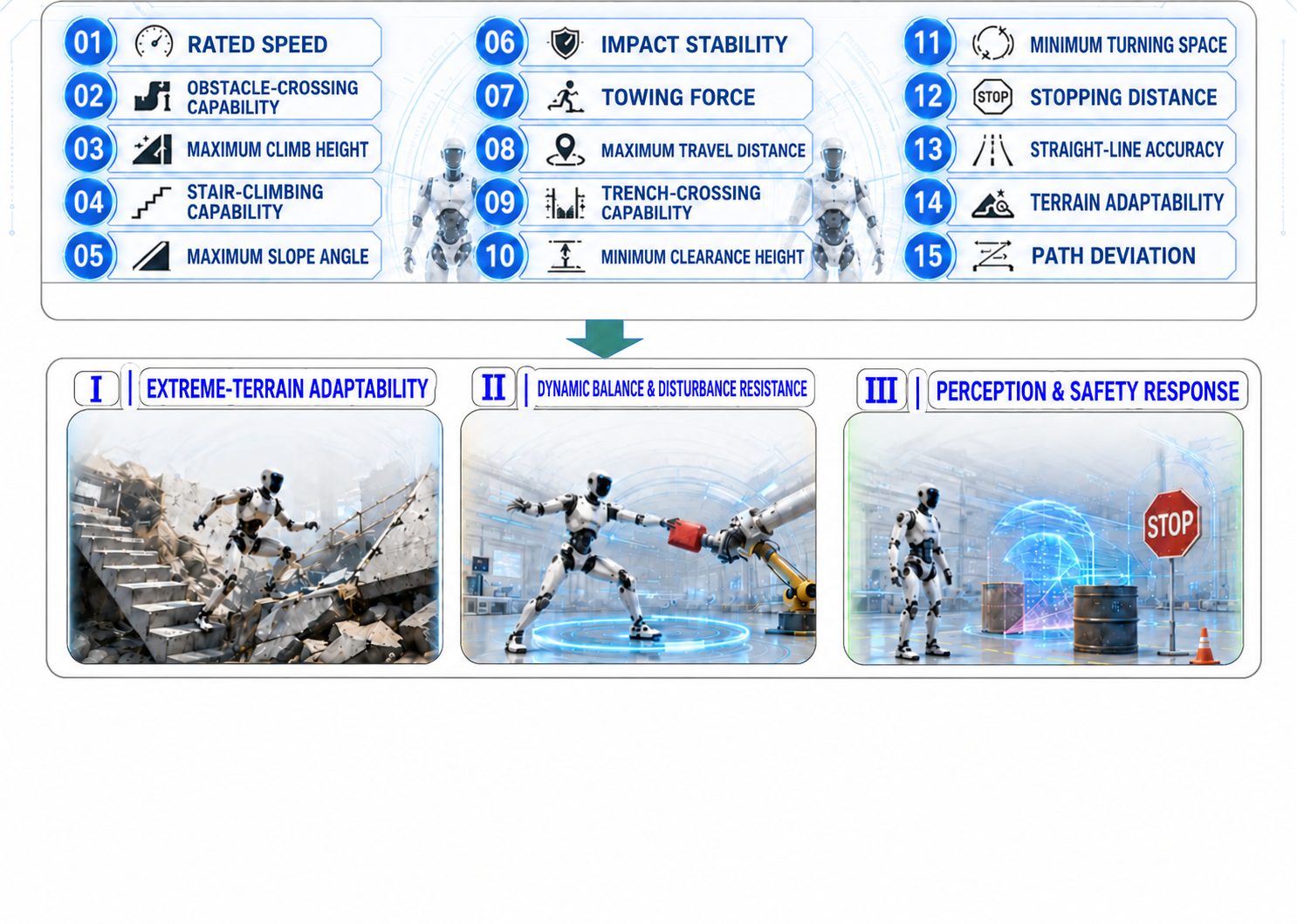
Fourth, companies can participate in co-design through inspection and testing data. The whole-machine performance items covered by ISO 18646-5—including stair traversal, obstacle crossing, maximum slope, transient impact, and stopping distance—are intended to evaluate a robot’s limits in terrain adaptability, dynamic balance, disturbance resistance, perception, and safety response, as shown in Figure 7. Ultimately, these performance indicators can be traced back to actuator thrust or torque, backlash, rigidity, efficiency, temperature rise, and control latency. If suppliers can provide data on load spectra, accelerated lifetime, post-impact accuracy, thermal equilibrium, and backdrivability, they can translate “machining accuracy” into the mission performance that robot manufacturers truly care about.
 |
Cost Reduction Should Not Rely Only on Scaling Up; Design and Process Must Advance Together
Cost reduction in humanoid robots should not be understood as simply cutting prices across existing components. More effective development pathways include increasing commonality through platform-based dimensions and interfaces; assigning screws and reducers according to joint load classifications to avoid overdesign across the entire robot; introducing DFM and DFA to reduce part counts, machined surfaces, and calibration steps; using in-line measurement and error compensation to relax individual machining tolerances while maintaining output performance through system-level calibration; and establishing statistical process control for key characteristics to reduce scrap, rework, and selective assembly costs. Domestic materials, cutting tools, heat treatment, and measurement equipment should also be incorporated from the early design stage to avoid continued dependence on expensive imported components after prototyping succeeds.
Machine tool builders can develop compound machining solutions and dedicated machines for screws, gears, and thin-wall parts. Component suppliers can establish serialized actuation and reduction modules. Automation companies can take on assembly, calibration, and final inspection lines. If these three groups collaborate through common specifications and data platforms, they can form a local supply chain covering materials, machining, assembly, and validation, rather than waiting separately for brand owners to place orders.
From Supplier to Co-Development Partner
As the supply-chain trend shown in Figure 8 indicates, brand owners tend to design and manufacture internally during the early stages of market development. As specifications gradually converge, motors, bearings, and structural parts are likely to see increased external procurement, while reducers, drives, and encoders are more likely to be co-developed with strategic partners. For Taiwanese companies, the best entry point is now, while standards are still being shaped and customers still need rapid iteration.
Companies should therefore build cross-disciplinary teams early, bringing together the mechanical, process, drive-control, and testing expertise required for joint modules to address customer needs as an integrated group. Instead of discussing only machining processes, they should focus on system-level indicators such as efficiency, temperature rise, noise, and lifetime. Through collaboration with research institutions such as PMC, III, ITRI, MIRDC, and academic partners, companies can establish layered validation from components and joints to complete machines. What they deliver should not be products alone, but the capability to shorten development time, reduce failure risk, and support mass-production ramp-up.
/MA%E5%9C%968-eng.jpg) |
Conclusion
The rise of humanoid robots is opening a market for Taiwan’s precision machinery industry that combines familiar technologies with entirely new demands. Humanoid robots require high-precision machining, but not static accuracy alone. They require transmission components, but place even greater emphasis on power density, impact resistance, thermal performance, and lifetime. They require automation equipment, but also demand data traceability and whole-machine mission validation. The real opportunity lies in recombining existing precision machinery capabilities into joint and process platforms that can be manufactured at scale.
The next wave of competition will not belong only to the brands that are first to launch humanoid robots. It will also belong to the manufacturing teams that can make joints more affordable, more reliable, and faster to mass produce. If Taiwan can move from build-to-print processing toward co-design, from single components toward modular products, and from outgoing inspection toward full-lifecycle data, it will be well positioned to turn the deep foundation of its precision machinery industry into an irreplaceable manufacturing advantage in the global humanoid robot supply chain.
References
[1] Global Market Insights Inc., “Humanoid Robot Market Size—By Component, Product Type, Application, End Use—Global Forecast, 2026–2035,” 2026. URL: https://www.gminsights.com/industry-analysis/humanoid-robot-market
[2] Tsung-Yuan Ko, industry analysis materials related to the humanoid robot market and price positioning, Market Intelligence & Consulting Institute (MIC), Institute for Information Industry, presented at the AMRA Seminar, August 20, 2026.
[3] Bank of America Institute, Physical AI, Part 2: Humanoid Robots, Exhibit 6, 2026. BOM cost proportions for humanoid robots are cited from BofA Global Research’s 2030 estimates.
[4] International Organization for Standardization, ISO 18646-5:2026 Robotics—Performance Criteria and Related Test Methods for Service Robots—Part 5: Locomotion for Legged Robots, ISO, Geneva, Switzerland, 2026.
[5] McKinsey & Company, Turning Humanoid Supply Chain Constraints into Billion-Dollar Wins, 2026.


