

Smart Manufacturing Meets Localization: India’s Machine Tool Technology Trends at AMTEX 2026
Exhibition Trends and Observations at AMTEX 2026
1. Overall Exhibition Trends: Complete Machines Take Center Stage, While Smart Functions Move toward Practical Applications
Based on observations at AMTEX 2026, the larger machine tool booths included BHAVYA MACHINE TOOLS, LMW, UCAM INDIA, JYOTI CNC AUTOMATION, TSUGAMI, ACE MICROMATIC, GLOBAL CNC, and COSMOS IMPEX. Exhibits were centered on CNC lathes, vertical and horizontal machining centers, multitasking machines, five-axis equipment, and automation cells. At the same time, conventional lathes and milling machines, along with more affordable standard models, continued to occupy a meaningful share of the show floor. This reflects the coexistence of two types of demand in India: equipment upgrades among large manufacturers and replacement of basic machinery among small and medium-sized enterprises.
The “smart” capabilities presented at the exhibition did not focus solely on artificial intelligence. Instead, they emphasized functions that can directly improve production management, including machine connectivity, utilization and output monitoring, tool-life management, machine health diagnostics, abnormal-condition alerts, robotic loading and unloading, and flexible automation. This trend indicates that Indian buyers remain highly attentive to return on investment, capacity improvement, and ease of maintenance. Smart functions must therefore integrate effectively with existing equipment, workforce capabilities, and production processes.
2. Indian Machine Tool Builders Shift from Equipment Manufacturing to Integrated Services
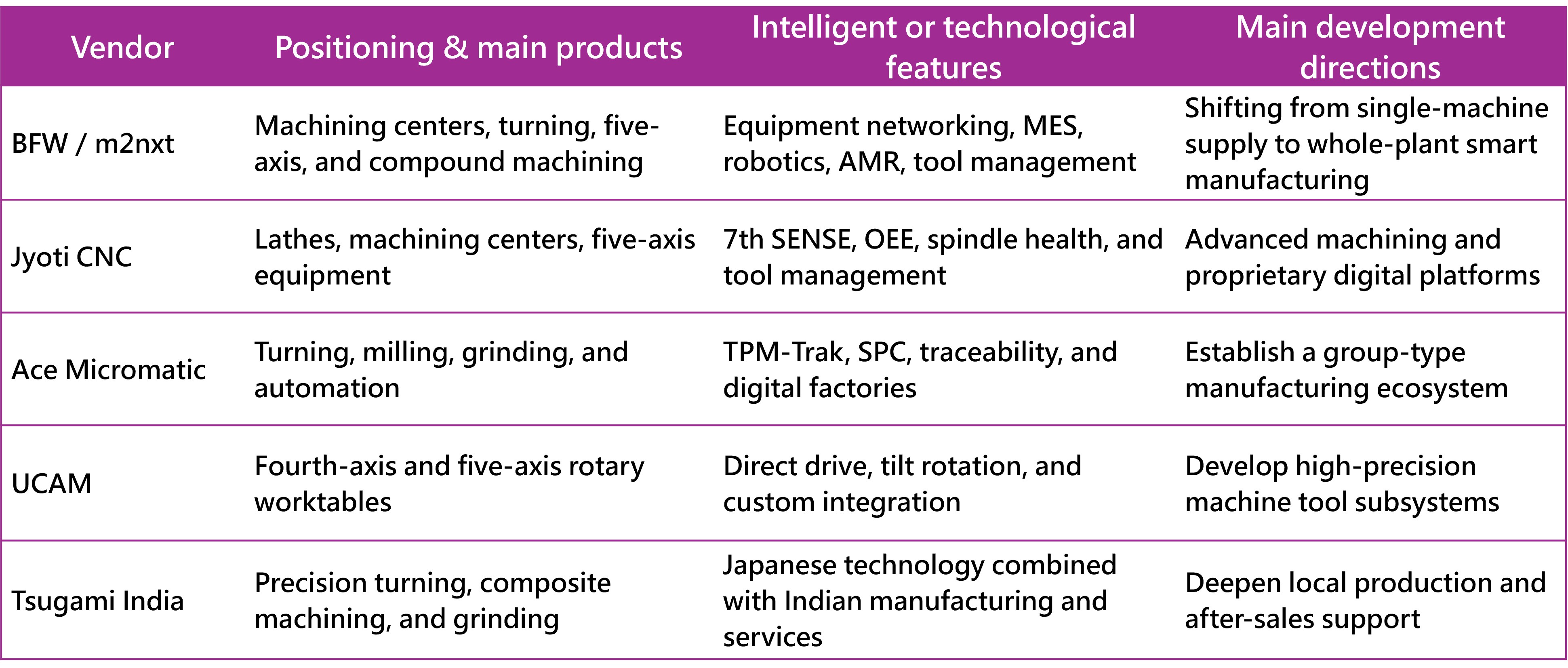
BFW (Bharat Fritz Werner) is one of India’s representative suppliers of machining equipment and solutions. Its portfolio spans vertical and horizontal machining centers, turning equipment, five-axis machines, and turn-mill machines. A defining feature of its development is the extension of conventional machine tools into cyber-physical integration services through its subsidiary, m2nxt. Publicly available m2nxt solutions include IRIS machine connectivity, iMES manufacturing execution management, tool management, robotic and gantry loading and unloading, assembly lines, measurement systems, autonomous mobile robots (AMRs), and metal additive manufacturing. Applications cover automotive, electric vehicles, casting and forging, aerospace, defense, and rail transportation. This demonstrates that major Indian machine tool builders are shifting from selling individual machines to delivering integrated packages of equipment, processes, automation, and data.
Jyoti CNC Automation, meanwhile, demonstrates the ambition of Indian manufacturers to enter the high-end machining and digital manufacturing markets. Its portfolio includes CNC lathes, turn-mill machines, vertical and horizontal machining centers, and a range of five-axis machining centers. The GU Five series is a moving-gantry five-axis machining center designed for high-speed, high-precision machining of complex workpieces, serving the needs of aerospace, automotive, medical, and precision machining industries.
In smart manufacturing, Jyoti has developed its own “7th SENSE” Industry 4.0 platform, integrating real-time overall equipment effectiveness (OEE), production scheduling, machine status, downtime causes, tool life, and cloud or on-premises data management. Sensors can also monitor spindle-bearing temperature, vibration, load, coolant, hydraulic pressure, air pressure, and lubrication status. The focus is not merely on connecting machines to a network, but on integrating production, maintenance, and tool management within a single platform. This shows that Indian machine tool builders are beginning to establish proprietary smart manufacturing software capabilities.
/AMTEX%20%E5%9C%96%E7%89%871.jpg) |
/AMTEX%20%E5%9C%96%E7%89%872-2.jpg) |
Source: Jyoti official website
3. Group-Based Product Deployment: Ace Micromatic
Ace Micromatic is distinguished by its group-based approach to building a comprehensive manufacturing ecosystem. Its portfolio covers CNC turning, milling, grinding, five-axis machining, automation, additive manufacturing, and after-sales service, supporting the automotive, aerospace, die and mold, electronics, energy, pump and motor, medical, and general machining sectors. The group’s smart manufacturing solutions include real-time OEE and output analysis, equipment maintenance, process-parameter monitoring, statistical process control (SPC), Andon visual management, product traceability, and digital factory applications. TPM-Trak, for example, can automatically acquire data from CNC machines or measuring devices for real-time quality and process analysis. This development model indicates that leading Indian companies are seeking to integrate machine tools, automation, quality data, and after-sales service into long-term operational platforms rather than compete solely on hardware specifications.
4. Specialized Components and Localization by Foreign Companies
Compared with complete-machine exhibitors, fewer booths at AMTEX 2026 focused exclusively on components such as spindles, turrets, tool magazines, linear guideways, and ball screws. Nevertheless, Indian specialist component makers are gradually moving toward higher-value products. UCAM is a representative example. Its offerings include fourth-axis CNC rotary tables, multi-station rotary systems for mass production, five-axis tilting rotary tables, direct-drive rotary tables, and customized products. UCAM states that it has more than 35 years of experience in precision rotary tables and has established a nationwide service network in India, demonstrating that local suppliers have developed capabilities in rotary axes and selected machine tool subsystems.
/AMTEX%20%E5%9C%96%E7%89%873.jpg) |
Among foreign companies, Japan’s Tsugami provides a representative example of localization in India. Tsugami Precision Engineering India established an integrated manufacturing facility in Chennai in 2013. Its portfolio includes sliding-headstock CNC automatic lathes, turning centers, turn-mill and mill-turn machines, machining centers, and cylindrical grinding machines. Rather than relying solely on imported equipment, its model combines manufacturing in India with spare-parts supply and after-sales service, showing how international brands are using local production and service capacity to reduce lead-time and maintenance barriers.
 |
Source: PMC (2026)
5. Machine Tool Components
Independent component booths were relatively limited at AMTEX. At the Taiwan–India Smart Manufacturing Forum, a representative of India’s COSMOS noted that CNC machine tool assembly in India continues to grow, while key items such as ball screws, linear guideways, CNC controllers, servo drives, and hydraulic systems remain highly dependent on imports. This statement is consistent with observations from the exhibition: India has developed capabilities in complete-machine design, castings, assembly, and selected rotary tables, but the domestic supply chain for high-precision core components is still evolving. Opportunities for Taiwanese companies should therefore extend beyond price competition and focus on products that enhance machine performance, including high-speed, high-precision spindles, driven turrets, rotary tables, tool magazines, linear guideways, ball screws, sensors, and machine health monitoring modules. These should be supported by sample testing, technical integration, local spare parts, and after-sales service. The rapid growth of smart manufacturing capabilities among Indian companies also means that Taiwanese suppliers must move beyond “component sales” toward integrated collaboration combining components, control parameters, monitoring functions, and application services.
Market Entry Strategies for India
1. Market Opportunities and Price Competition
Ongoing capacity expansion in India’s automotive and electric vehicle, aerospace and defense, rail transportation, energy equipment, die and mold, and general metalworking industries is driving demand for CNC machine tools, automation equipment, and precision components. However, the Indian market does not operate within a single price band. Large enterprises emphasize machining accuracy, capacity, equipment stability, and after-sales service, while small and medium-sized manufacturers are highly sensitive to initial acquisition costs. This creates a market structure in which high-end smart equipment and economical machine models coexist.
At this exhibition, lower- and mid-range products attracted substantial inquiries, but some buyers pressed for steep price concessions. This should be analyzed in the context of competition from low-cost local machines, Chinese products, locally made equipment, and second-hand machinery, as well as buyers’ limited understanding of product differentiation. In contrast, Taiwanese companies with experience in India generally believe that customized, high-precision products or solutions capable of resolving specific machining problems are better positioned to demonstrate value.
2. Tariffs, Logistics, and Regulatory Costs
The cost of exporting machine tools to India cannot be assessed solely on an FOB or ex-works basis. Import costs generally include sea or air freight, insurance, Basic Customs Duty (BCD), the Social Welfare Surcharge where applicable, Integrated Goods and Services Tax (IGST) on imports, port and customs clearance charges, inland transportation, warehousing, installation, and after-sales service. According to India’s Central Board of Indirect Taxes and Customs, import IGST may, subject to applicable rules, be claimed as input tax credit by a registered importer, whereas BCD is not creditable and therefore becomes an actual cost.
/%E5%9C%96%E7%89%876-ENG.jpg) |
Source: PMC (2026)
Products with the same general name may fall under different tariff classifications depending on their structure, intended use, controller, or motor configuration. The main text should therefore avoid stating a single tariff rate. Before export, the Indian importer or a customs professional should confirm the eight-digit code and use the Indian Customs ICEGATE Customs Duty Calculator to verify the rate and preferential notifications applicable on the declaration date.
On the regulatory front, India’s Ministry of Heavy Industries withdrew the “Machinery and Electrical Equipment Safety (Omnibus Technical Regulation) Order, 2024” in January 2026. Its withdrawal does not mean that all products are exempt from BIS certification or quality control requirements. Individual components, electrical products, and tender projects may still be subject to other Quality Control Orders (QCOs), Indian standards, or procurement specifications, and must therefore be checked item by item before shipment.
3. Local Manufacturing Models and Local-Content Rules in Government Procurement
During an exchange dinner with the local Taiwanese business community, participants suggested exporting parts to India for assembly by local companies. Although this model has practical precedents in the electronics industry, complete machine tools involve geometric accuracy, spindle balancing, control parameters, positioning compensation, trial cutting, validation, and safety responsibilities. The simplified assembly model used for electronic products should therefore not be applied directly to machine tools.
Under India’s foreign direct investment policy, foreign investment in manufacturing is generally permitted through the automatic route. Manufacturing may be carried out directly by the investee entity or contracted to an Indian manufacturer through a legally binding agreement. Taiwanese companies may therefore pursue localization through joint ventures, subsidiaries, or contract manufacturing, but must simultaneously establish clear rules for quality responsibility, technology licensing, intellectual property rights, parts traceability, and acceptance. Where Indian government procurement is the target, “Make in India” preference is calculated on the basis of local value addition, not merely the location of final assembly. Under the current public procurement framework, suppliers with local content of 50% or more are generally classified as Class-I local suppliers, while those with 20% or more but less than 50% are classified as Class-II local suppliers. Imported content and related customs duties are included in the calculation, and competent ministries may impose higher thresholds for specific products. Consequently, importing most of a complete machine or module from Taiwan and performing only fastening and packaging in India may not be sufficient to qualify as a local supplier for government procurement.
4. A Phased Localization Strategy Is Recommended
India is geographically vast, and its states differ substantially in industrial clusters, land conditions, taxation, labor management, infrastructure, and administrative efficiency. Machine tools also require installation, accuracy calibration, application engineering, and prompt maintenance. Investing directly in a full-scale factory before establishing a stable customer base may therefore create excessive fixed costs and management risks.
Site selection should be aligned with target customers rather than determined solely by land costs. Bengaluru, for example, is suitable for cooperation in machine tools, aerospace, and smart manufacturing. Pune and the Mumbai region provide access to the automotive, metalworking, and die and mold industries. Chennai and Coimbatore have strong foundations in automotive components, casting and forging, and precision machining. In Gujarat, companies may further focus on industrial corridors such as Ahmedabad–Sanand and Rajkot.
/%E5%9C%96%E7%89%877-ENG.jpg) |
Source: PMC (2026)
Conclusions and Recommendations for Follow-up Action
1. India’s Dual-Track Market Upgrade and Entry Opportunities for Taiwan
The AMTEX 2026 study shows that India’s machine tool market is advancing along two parallel tracks: expansion of basic equipment and upgrading toward high-end smart manufacturing. Small and medium-sized manufacturers continue to value affordable, easy-to-operate and easy-to-maintain lathes, milling machines, and standard CNC equipment. Meanwhile, automotive and electric vehicle, aerospace and defense, rail transportation, die and mold, and precision machining companies are increasing demand for five-axis and multitasking machines, automated loading and unloading, machine connectivity, and production management systems. Major Indian machine tool builders have moved beyond standalone machine sales toward integration of automation, OEE, tool management, and health diagnostics, while foreign companies are using local manufacturing and service to reduce lead-time and maintenance barriers. In contrast, independent supply of high-precision spindles, turrets, tool magazines, linear guideways, ball screws, and smart sensing modules remains relatively limited at the exhibition. This creates opportunities for Taiwan to enter through high-precision core components and application services that help Indian machine builders improve performance and reliability.
2. R&D for Smart Components and Differentiated Value
Although the Indian market is price-conscious, purchasing decisions are not based on unit price alone. Production efficiency, accuracy stability, maintenance speed, and downtime risk are equally important. If Taiwanese smart components are supplied only as standalone hardware, buyers can easily compare them directly with Indian or Chinese products. Greater differentiation can be achieved by integrating precision mechanisms, sensing, diagnostics, communications, and application services. Future R&D for smart components should prioritize modules such as smart spindles, turrets and tool magazines, rotary tables, linear guideways, and ball screws, incorporating monitoring of vibration, temperature, load, positioning, lubrication, wear, and remaining useful life. Interfaces should also be provided for data exchange with mainstream CNC systems, machine connectivity solutions, and Indian local management platforms. PMC can help establish common testing methods, data formats, health indicators, and long-duration operation validation, enabling product claims to progress from “equipped with sensing functions” to quantifiable improvements in downtime, maintenance cost, accuracy, and capacity.
3. Deepening Local Partnerships and Converting Opportunities into Business
AMTEX 2026 demonstrates that India is no longer merely a market for low-cost equipment. It is a growth market characterized by simultaneous demand for manufacturing scale-up, equipment upgrading, localization, and smart manufacturing. The Taiwan Pavilion has already generated industry visibility, technical exchanges, buyer engagement, and preliminary business opportunities. The next stage is to convert exhibition contacts into testing, quotations, agency arrangements, sample validation, and orders, while channeling buyer feedback into domestic R&D and product specification adjustments. Taiwanese companies can adopt a phased approach: first validate the market through agents, system integrators, and reference customers; then gradually establish service sites, spare-parts warehouses, engineering support, and local assembly capabilities; and, for regions or customers with sustained long-term demand, evaluate joint ventures, contract manufacturing, or co-branding. Only by connecting R&D programs, overseas promotion, local partners, and after-sales service can Taiwan establish a sustainable model for bringing its smart machinery solutions into the Indian market.
References
- Economic Division, Taipei Economic and Cultural Center in India, Overview of India’s Machine Tool Industry, July 31, 2026.
- Department of Investment Promotion, Ministry of Economic Affairs, Investment Environment in India, July 2026.
- Post-show statistics provided directly by RX India, organizer of AMTEX 2026, 2026.
- Asian Community News, “20 Taiwanese Companies Showcased Smart Manufacturing Strength at AMTEX,” August 2, 2026.
- RX India/AMTEX press release, “AMTEX and Fastener Fair India Bring India’s Manufacturing Ecosystem Together,” 2026.
- Central Board of Indirect Taxes and Customs, “GST—Imports.”
- Indian Customs Electronic Gateway, Customs Duty Calculator.
- Department for Promotion of Industry and Internal Trade, “Consolidated FDI Policy.”
- Department for Promotion of Industry and Internal Trade, “Public Procurement (Preference to Make in India), Revised Order.”
- Ministry of Heavy Industries, “Withdrawal of the Machinery and Electrical Equipment Safety (Omnibus Technical Regulation) Order, 2024,” January 16, 2026.


