

Reframing Net Zero: Measuring and Leveraging Avoided Emissions
I. Introduction
In the global transition toward net-zero emissions, the role of enterprises is undergoing a fundamental transformation. Traditionally, companies have been regarded as primary sources of carbon emissions and have been required to reduce emissions generated by their own operations. However, sustainable development also encompasses economic and social dimensions. Given the urgency of the climate crisis, a broader and more practical perspective is needed—one that empowers businesses to become solution providers.
The Guidance on Avoided Emissions, initiated by the World Business Council for Sustainable Development (WBCSD), was developed against this backdrop.
Companies should not merely be viewed as sources of greenhouse gas (GHG) emissions. Through innovation in products and services, they can serve as engines that help society and markets achieve decarbonization. The avoided emissions guidance encourages companies to compare the low-carbon outcomes created by their climate solutions with the most likely alternative scenarios in the market, thereby clearly demonstrating their positive contribution to decarbonization goals. This represents not only a technical method of quantification but also a fundamental shift in mitigation thinking.
II. Avoided Emissions Assessment
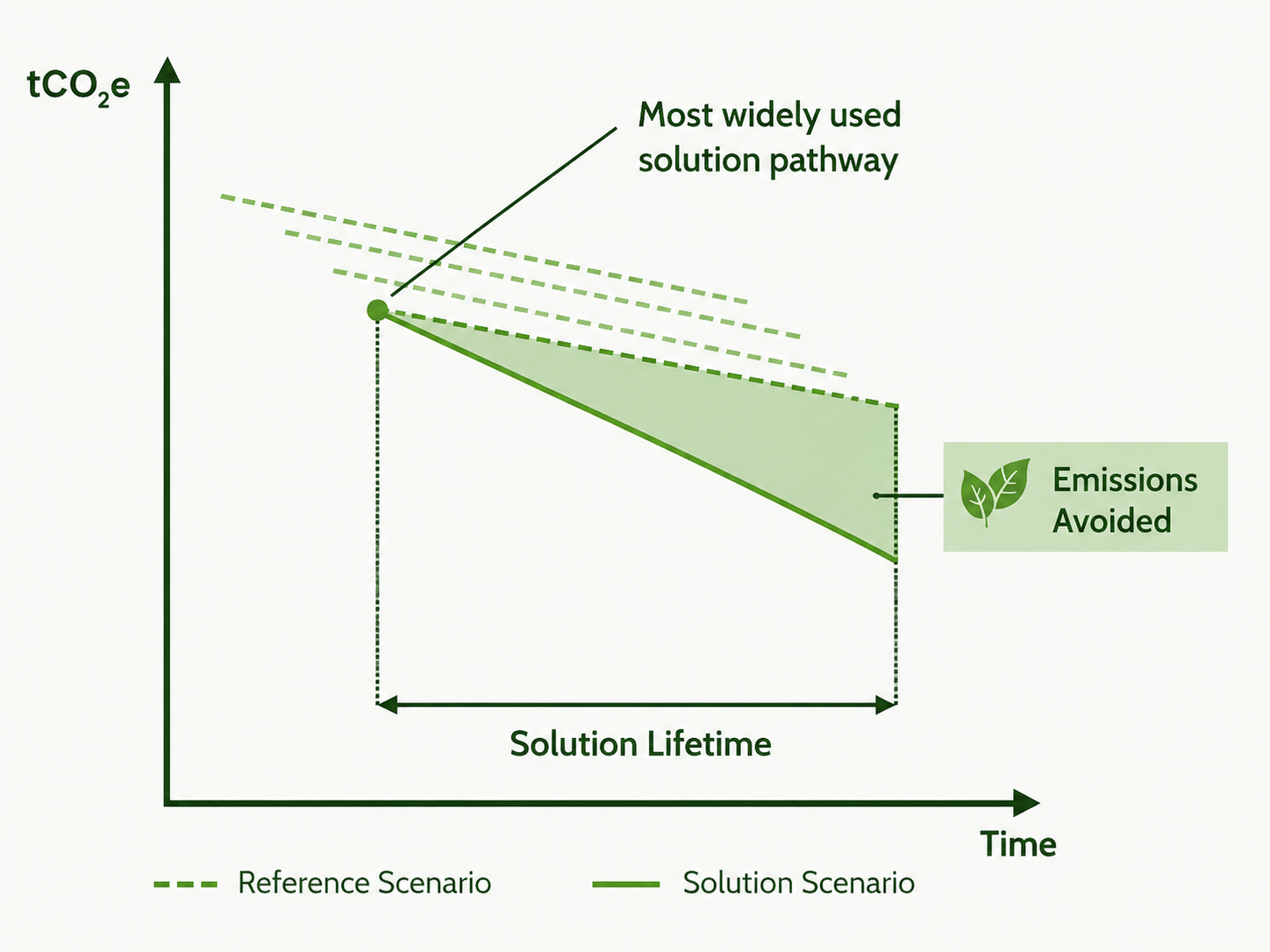
Avoided emissions refer to the positive impact derived from comparing the GHG emissions of a given product or service solution with the emissions that would most likely occur in the absence of that solution. In simple terms, when the emissions of the solution scenario are lower than those of the reference scenario, the difference constitutes avoided emissions.
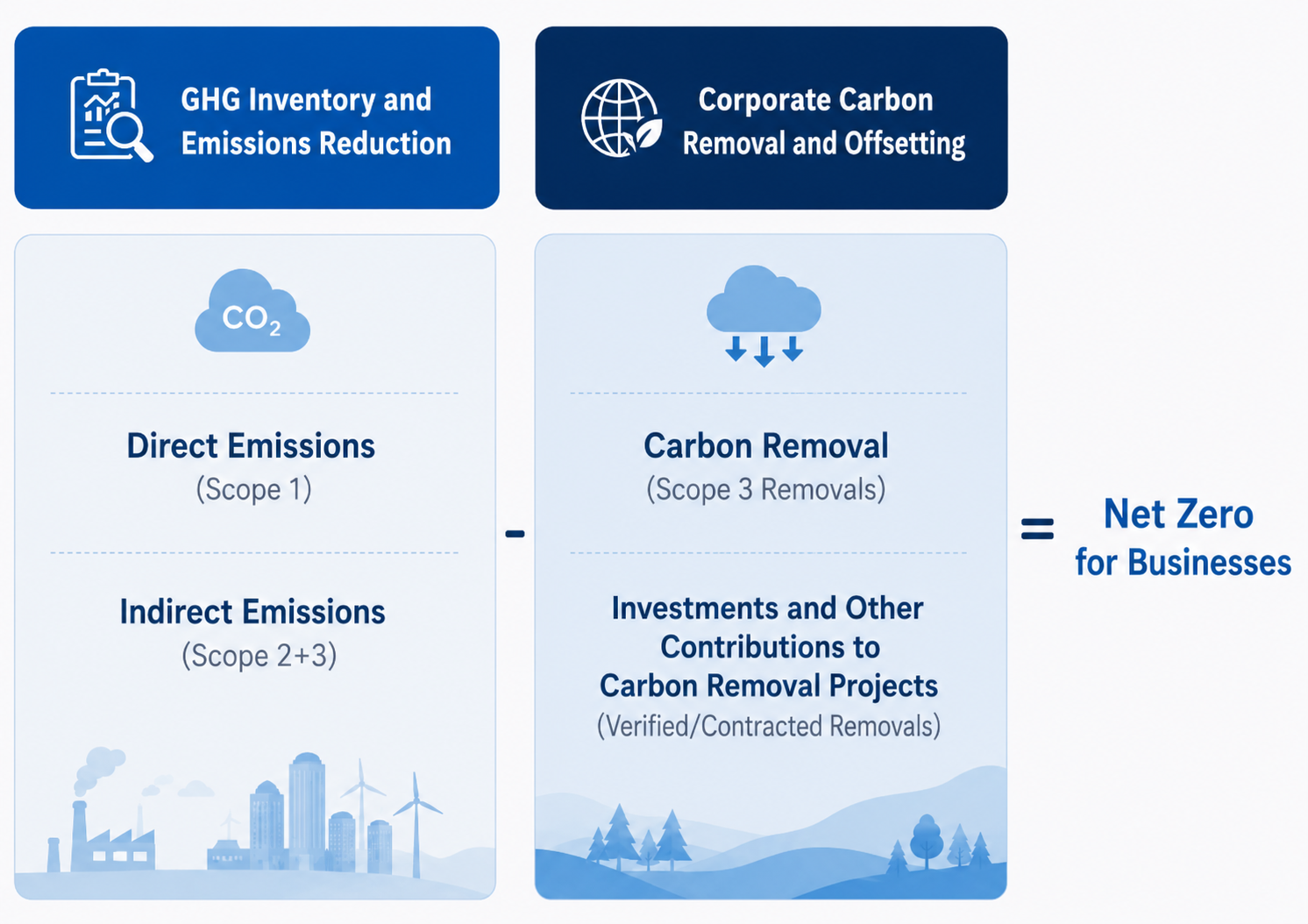
It is important to distinguish avoided emissions from Scope 1, 2, and 3 emissions in organizational GHG inventories. GHG inventories are retrospective, measuring total emissions within a defined period (e.g., one year), whereas avoided emissions are comparative, focusing on the difference between two potential pathways, as illustrated in Figure 1.
 |
Source: Guidance on Avoided Emissions by WBCSD (2026), compiled by the author
For example, manufacturing LED light bulbs may generate emissions similar to those of traditional bulbs. However, due to significantly lower electricity consumption during use, LEDs create substantial avoided emissions compared to the alternative. Similarly, producing high-performance glass may increase a manufacturer’s Scope 1 and Scope 2 emissions, but for building owners, the improved energy efficiency significantly reduces operational emissions. This “complementary” perspective enables companies to gain recognition for decarbonization beyond their operational boundaries. Importantly, avoided emissions should not be used to offset or compensate for a company’s own emission inventory.
Assessing avoided emissions requires rigorous thresholds and scientific quantification to ensure transparency and credibility. The process can be divided into qualification screening, application of core principles, emissions quantification, and subsequent monitoring.
1. Qualification Criteria
Before calculation, companies and solutions must pass three thresholds to ensure integrity and prevent greenwashing:
(1) Credibility of climate action: Companies must have science-based targets aligned with climate goals (e.g., a 1.5°C pathway) and regularly disclose third-party–verified Scope 1, 2, and 3 emissions.
(2) Alignment with latest climate science: Solutions must be recognized as having mitigation potential by sources such as the IPCC or sustainability taxonomies (e.g., EU taxonomy). They must not support fossil fuel extraction, production, or sales, nor extend the lifetime of high-emission assets.
(3) Legitimacy of contribution: Companies must demonstrate a clear causal relationship between the solution and emission reductions, and the reductions must be significant.
2. Core Principles
Six principles must guide the assessment to ensure robustness:
(1) Transparency: Disclose all relevant data and assumptions.
(2) Conservativeness: When in doubt, choose assumptions that result in lower avoided emissions.
(3) Accuracy: Minimize uncertainty in data and methodology.
(4) Relevance: Use appropriate data, methods, and assumptions.
(5) Completeness: Consider all relevant information affecting quantification.
(6) Consistency: Follow guidance to ensure methodological coherence.
3. Emissions Quantification
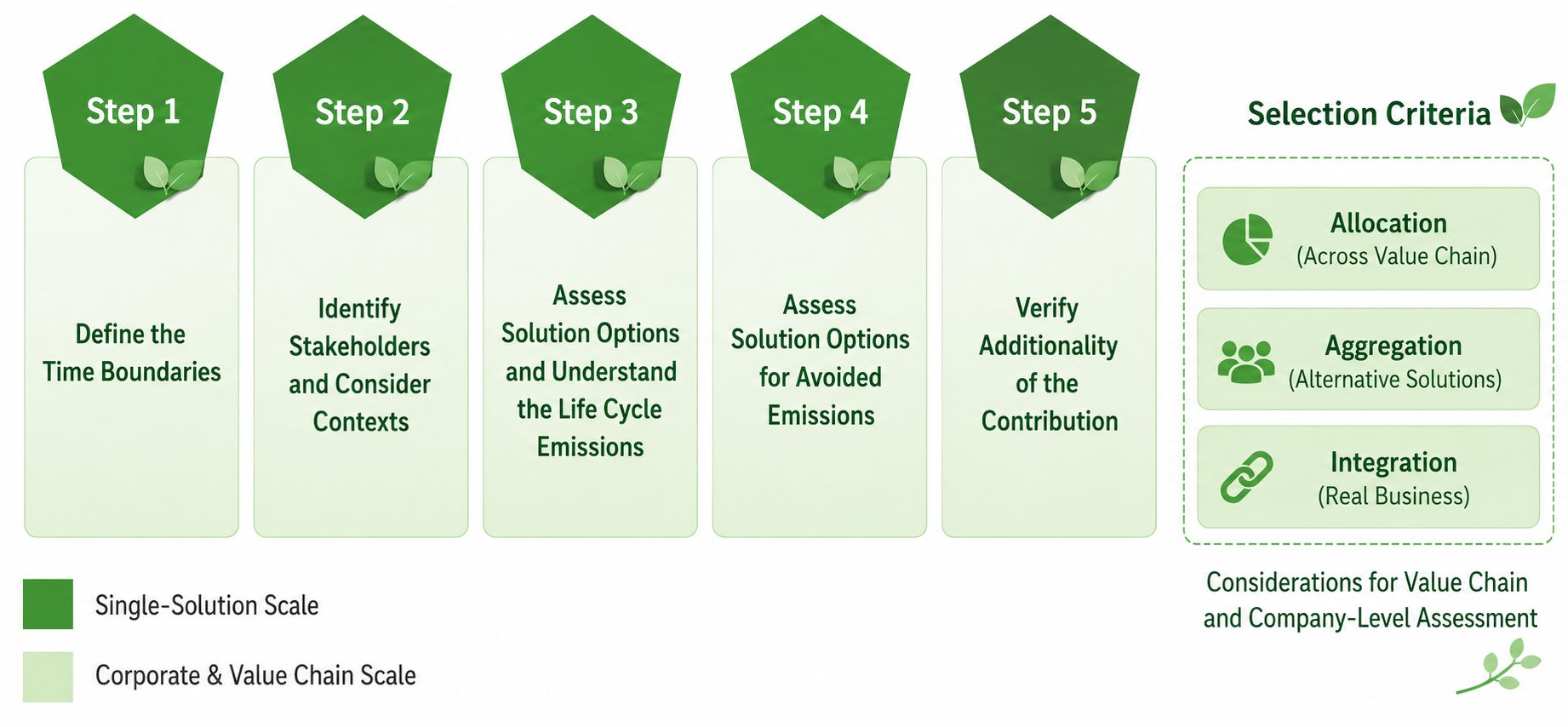
This is the core of the assessment, comparing the solution scenario with the reference scenario, as shown in Figure 2.
 |
Source: Guidance on Avoided Emissions by WBCSD (2026), compiled by the author
(1) Define time boundaries:
- Ex-post (year-on-year) method: Evaluates realized avoided emissions annually, suitable for trackable solutions.
- Ex-ante method: Estimates lifetime avoided emissions at the point of sale, suitable for consumer goods.
- Time boundaries should align with organizational GHG inventory periods.
(2) Define the reference scenario:
- “New demand” scenarios using standard market solutions with similar functions;
- “Existing demand” scenarios involving improvement or replacement.
Regulatory requirements must also be considered. (See Figure 3.)
 |
Source: Guidance on Avoided Emissions by WBCSD (2026), compiled by the author
Represents the most likely alternative without the solution. This may involve:
(3) Assess lifecycle emissions:
Define a functional unit (e.g., “providing heating to a household for 10 years”) and calculate cradle-to-grave emissions. Priority should be given to primary data, with secondary data used only when necessary.
(4) Calculate avoided emissions:
Δ Greenhouse Gas Emissions = (Total emissions in the reference scenario) − (Total emissions in the solution scenario)
A positive value represents avoided emissions.
(5) Validate contribution:
Reassess results to confirm the significance of reductions and exclude rebound effects.
4. Monitoring and Tracking
When scaling from individual products to company-level assessment:
(1) Allocation and attribution: Establish fair allocation across value chain participants.
(2) Aggregation: Avoid mixing different markets, technologies, or functional units, and do not offset against inventory reductions.
(3) Traceability and monitoring: Use digital tools to track real-world performance.
(4) Communication and reporting: Third-party verification is recommended to enhance comparability.
III. Applications of Avoided Emissions
The value of avoided emissions lies not only in disclosure but also in strategic decision-making. It helps companies identify markets and solutions with the greatest decarbonization impact. This enables R&D teams to shift resources toward high-efficiency, low-carbon technologies and maximize climate value from investments.
In market positioning, quantifying customer-side emission reductions allows companies to differentiate themselves and gain advantages in sustainable supply chains. Standardized methods also help establish credible claims and mitigate greenwashing risks.
From a financial perspective, avoided emissions data can guide investment toward companies with genuine long-term decarbonization potential, making it a key metric linking corporate value with transition finance. Ultimately, the guidance transforms invisible climate contributions into measurable and comparable outcomes, driving systemic decarbonization.
IV. Conclusion
Avoided emissions provide a framework that moves beyond traditional carbon-cost thinking, enabling companies to redefine competitive advantage in emission reduction. For firms already producing low-carbon components or offering energy-efficient services, this guidance is an effective tool to translate innovation into market leadership and demonstrate progress toward net zero.
Companies today face unprecedented pressure to reduce emissions, alongside stricter scrutiny of greenwashing. Without a solid scientific basis, any emission reduction claims may expose firms to legal and reputational risks. Additionally, supply chain and financial pressures demand more precise impact data from investors and major clients.
In conclusion, only by aligning with standardized measurement frameworks can companies unlock the full commercial potential of climate solutions under transparent and credible conditions. The Guidance on Avoided Emissions will be a critical tool for achieving net-zero targets in the global transition.


