

AMB 2026: Practical Solutions for European Manufacturing
Held biennially, AMB—one of the world’s flagship metalworking exhibitions—returned to Messe Stuttgart from September 15 to 19, 2026. The show brought together 1,195 leading exhibitors from 34 countries and attracted approximately 65,000 trade visitors from 76 countries over five days. Visitors with purchasing or investment decision-making authority accounted for 68% of total attendance. This group included 14% from executive, corporate or plant management and 35% from production and process engineering, underscoring the event’s strong concentration of industry decision-makers.
In addition to dedicated halls organized around the process chain—including turn-mill machining, heavy-duty five-axis machining and intelligent workholding—the organizers introduced a defense and security industry forum and a special showcase featuring forward-looking technologies nominated for the AMB Award. Together, these elements highlighted the direction of European manufacturing: addressing labor shortages, refocusing on proven machining performance and pursuing greater supply-chain autonomy.
|


Source:PMC (2026)
Exhibition Overview: Pragmatic Buyingas as the Market Bottoms Out
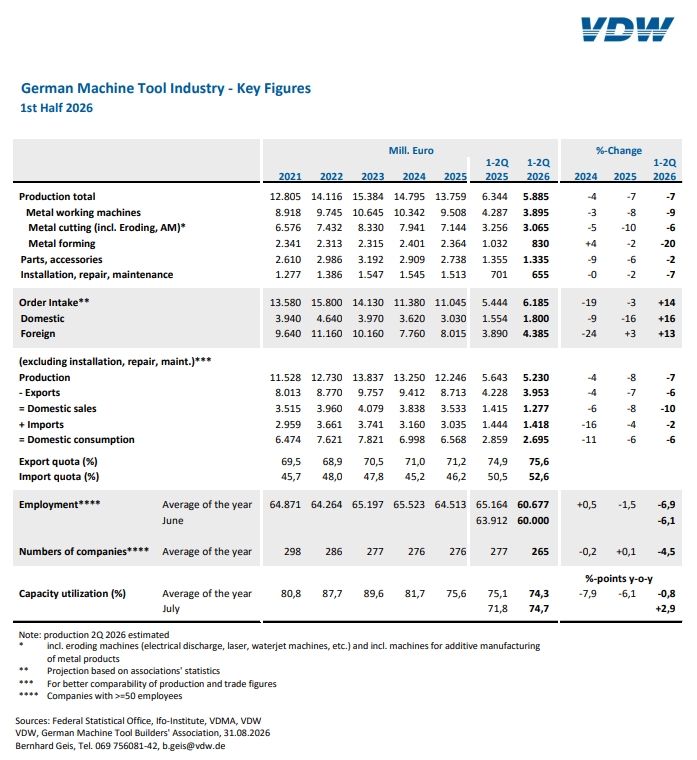
AMB 2026 took place at a pivotal moment after several consecutive years of contraction in European manufacturing. According to the latest industry data released by the German Machine Tool Builders’ Association (VDW) in September 2026, Europe’s manufacturing sector is showing signs of reaching a cyclical trough: orders are beginning to recover, although manufacturers are still adjusting capacity and working down inventories.
- Orders have bottomed out, while capacity utilization remains in an adjustment phase.
After three consecutive years of weak demand, orders received by Germany’s machine tool industry rose 14% year on year in the first half of 2026—15% in the first quarter and 12% in the second. Domestic orders increased by 16%, while overseas orders grew by 13%. Actual production and shipments, however, still declined by 7% year on year, and overall factory capacity utilization remained at approximately 74% to 75%. This indicates that end users have resumed evaluating capital expenditure, while production sites remain in a period of adjustment as they absorb existing capacity and inventories.
- Imported equipment reaches a record market share.
Under pressure from high energy costs and rising skilled-labor costs, imported equipment now holds a record 52.6% share of the German market. Competitive non-German suppliers—including those from Japan, South Korea, China and Taiwan—are attracting serious interest from European contract manufacturers because of their favorable price-performance ratios, strong automation-integration capabilities and reliable delivery.
- Workforce contraction and industry consolidation.
Average employment in the first half fell by 6.9% year on year to 60,677. This reflects Germany’s acute shortage of skilled workers—driven by retirements and recruitment difficulties—as well as industry consolidation caused by high operating costs. Small and medium-sized machine tool builders face growing pressure to merge or scale back production. These conditions also explain why German customers at the show were actively seeking lights-out machining cells, including AMRs and quick-change pallet systems, as well as turnkey solutions.
- A shift in end-market purchasing. Conventional internal-combustion-engine automotive components now account for only 23% of German machine tool sales. Growth is instead coming from aerospace and defense, renewable energy—especially wind power—and semiconductor processing and precision electronics. End users are no longer buying general-purpose three-axis machines simply to expand capacity; investment is shifting toward project-specific production of individual, high-value-added workpieces.
 |
Source:VDW (2026)
VDW Managing Director Dr. Markus Heering and Head of Economic and Statistical Affairs Bernhard Geis both described AMB 2026 as strongly project- and solution-oriented. Stefan Zecha, Chairman of the VDMA Precision Tools Association, likewise emphasized that manufacturers are moving beyond macroeconomic uncertainty and toward pragmatic investment in solutions to specific process bottlenecks. Across the exhibition halls and in discussions at exhibitor stands, AMB 2026 conveyed a distinctly practical tone: the emphasis has shifted from conceptual demonstrations back to proven machining performance.
 |
Source:PMC (2026)
The combined pressures of labor shortages and CBAM compliance are accelerating the adoption of lights-out production cells and greater energy transparency. Europe’s widening skilled-labor gap has transformed unattended machining from an option into an operational necessity, driving broader adoption of autonomous mobile robots (AMRs) for pallet handling, automatic tool changing and intelligent connectivity across multiple machines. At the same time, preparations for the EU Carbon Border Adjustment Mechanism (CBAM) are prompting control-system suppliers to make per-part electricity consumption (kWh/part) and real-time carbon-footprint data standard machine functions.
The signals from AMB 2026 show that Europe’s metalworking market is returning to the fundamentals of proven machining performance. At this critical juncture, as the industry bottoms out and begins to recover, only equipment and processes capable of consistently delivering first-part-right production—with minimal human intervention and the lowest possible energy consumption per part—will win firm orders from Europe’s demanding contract manufacturers.
Decoding European Manufacturing Trends at AMB
Under the theme “Where metal comes alive,” AMB 2026 demonstrated how metal cutting—combined with automation, artificial intelligence and circular-economy principles—is evolving beyond isolated machining processes into an intelligent manufacturing ecosystem characterized by self-monitoring, adaptive control and high energy efficiency.
Against the combined pressures of an economy nearing a cyclical trough, a widening skilled-labor gap and the implementation of the EU Carbon Border Adjustment Mechanism (CBAM), Europe’s metalworking sector presented a clear and consistent path toward industrial upgrading. The era of purchasing general-purpose machines merely to expand capacity is ending. In its place is strong, application-driven demand from the aerospace and defense, semiconductor equipment and energy-transition sectors. With proven machining performance at its core, the show highlighted three major technology trends: advanced process integration to achieve first-part-right production; automated quick-change interfaces to enable unattended operation in small and medium-sized cells; and digital-twin control combined with CBAM-aligned energy transparency to meet increasingly stringent sustainability requirements.
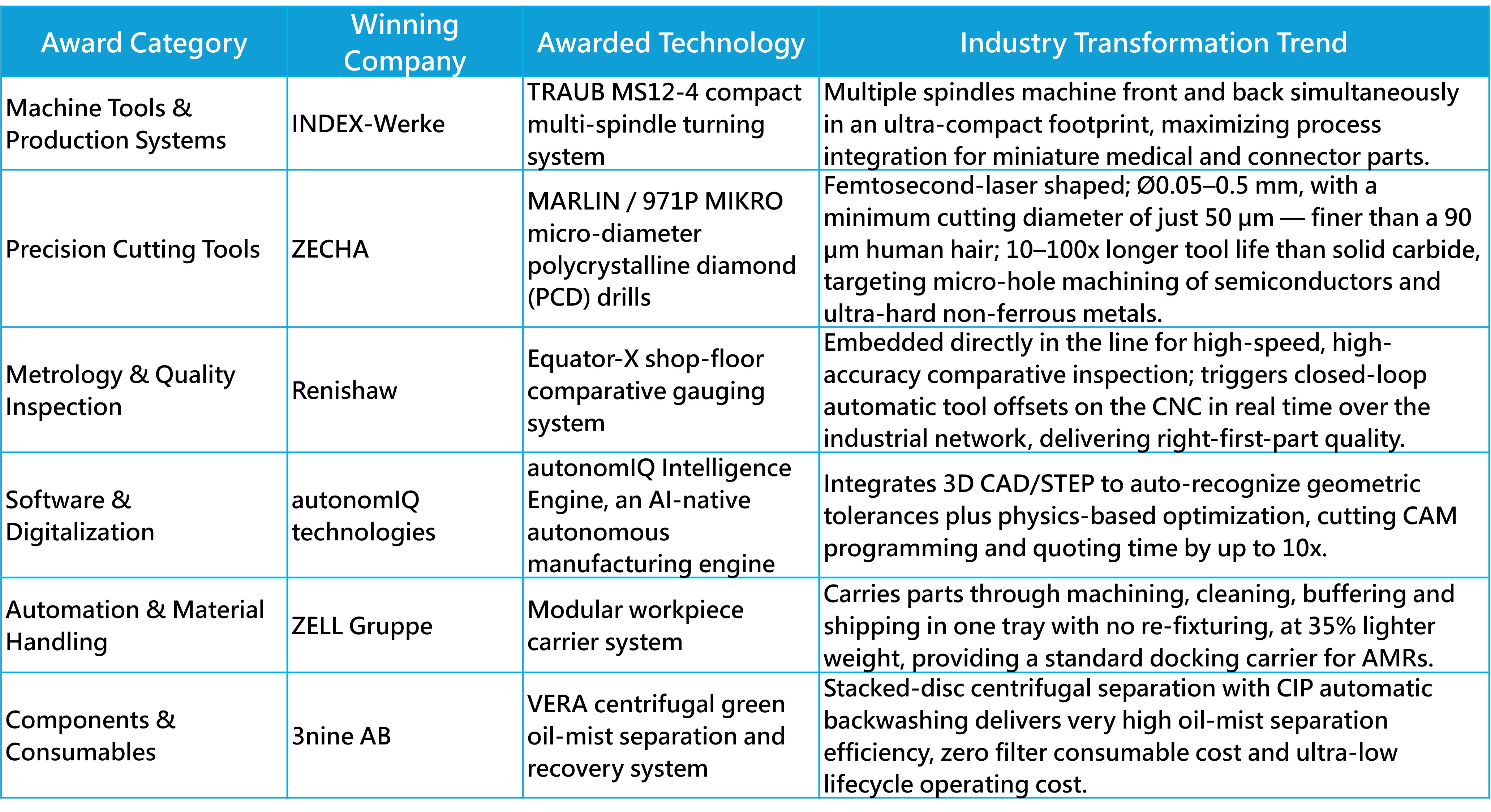
As a bellwether for advanced European manufacturing, the technologies recognized by the AMB Award 2026 closely reflected these transformation pathways. The table below summarizes the winners in the six award categories and shows how their technologies align with the prevailing direction of Europe’s metalworking industry.
 |
Source: AMB 2026; compiled by PMC.
Trend 1: Advanced Process Integration-Achieving First-Part-Right Production
To meet the machining requirements of difficult-to-cut aerospace and defense materials and ultra-precision semiconductor components, European manufacturers are seeking to eliminate repeated reclamping between machines, which can lead to cumulative tolerance errors and increase the risks associated with manual handling. At the show, advanced turn-mill integration was combined with active chip-breaking technology and rapid closed-loop inspection on the shop floor. Together, these capabilities link machining, inspection and tolerance compensation in a continuous process, enabling complete machining in a single setup and first-part-right production.
- INDEX-Werke GmbH & Co. KG: TRAUB MS12-4 Multi-Spindle Turning Machine
The TRAUB MS12-4 combines the process flexibility of a single-spindle sliding/fixed-headstock lathe with the productivity of a multi-spindle machine, enabling cost-effective precision machining within an exceptionally compact footprint. Its four main spindles are arranged vertically on four levels, each with its own tool turret; depending on the application, up to four Flex tool carriers can be added. Two or four counter spindles perform simultaneous rear-side machining, sharply reducing cycle times. Compared with four conventional single-spindle machines, the MS12-4 delivers four times the productivity within the same floor space while requiring only one control system and one set of peripheral equipment. Its exceptional output per unit of floor space and flexible configuration make it well suited to precision mechanics and robotics, electrical engineering, the watch and jewelry industry, and medical technology.
Figure 4. INDEX-Werke GmbH & Co. KG TRAUB MS12-4 Multi-Spindle Turning Machine
  |
資料來源:PMC (2026)
- Renishaw GmbH: Equator-X™ 500 Shop-Floor Gauging and Closed-Loop Tool Compensation
Designed for high-speed, high-accuracy inspection on the shop floor, the Equator-X™ 500 dual-method gauging system combines Absolute and Compare measurement modes in a single device. It replaces the time-consuming practice of sending parts to a metrology room for offline CMM inspection and can be installed directly beside the machine for rapid, highly repeatable post-machining measurement. Renishaw process-control software can then feed measurement data back to the machine-tool controller in real time and trigger automatic tool-offset updates, establishing closed-loop process control on the production line.
- Citizen Machinery Europe GmbH: LFV Low-Frequency Vibration Cutting Technology
When machining titanium alloys, Inconel and difficult-to-cut stainless steels, Citizen’s LFV technology applies low-frequency vibration in the feed direction. Periodic intervals of air cutting are created during each spindle rotation, breaking long, stringy chips into small, manageable segments. By preventing chip entanglement, chip-conveyor blockages and damage to finished surfaces, LFV supports clean, safe continuous machining and automated workpiece handling.
  |
Source:PMC (2026)
Trend 2: Automated Quick-Change Interfaces-Enabling Lights-Out Operation for Small and Medium-Sized Cells
Constrained by skilled-labor shortages and limited factory space, many small and medium-sized European contract manufacturers find conventional large-scale automation—with extensive infrastructure and safety fencing—too costly. AMB 2026 showcased a lights-out material-flow model built around standardized quick-change workholding and autonomous mobile robots (AMRs). This approach allows a single AMR to serve machines from different manufacturers, enabling highly flexible automation with a lower barrier to entry.
- DMG MORI: PH-AMR Autonomous Pallet-Handling System
A live demonstration showed the PH-AMR docking precisely with the loading side of a DMV-series machine and transferring a metal pallet weighing several hundred kilograms directly into the work area through a dedicated interface. A central dispatch system assigns each task autonomously, demonstrating a flexible manufacturing solution for small and medium-sized customers that requires no fixed guide rails and can be integrated into an existing plant.
  |
Source:PMC (2026)
- HAINBUCH GmbH: centroteX Quick Change-Over System
HAINBUCH, a German specialist in workholding technology, presented its centroteX quick change-over system. Depending on the centroteX variant, an operator or automation system can change workholding devices such as three-jaw chucks in approximately two minutes or less, with interface repeatability of ≤ 0.003 mm and no realignment required. By sharply reducing setup-related downtime, the system provides essential changeover efficiency for Europe’s high-mix, low-volume flexible machining cells.
 |
Source:PMC (2026)
- ZELL Group: ZELL® Factory Modular Workpiece Carrier and Transfer System
Designed for high-mix, low-volume production at small and medium-sized factories, the ZELL® Factory System uses highly interchangeable modular part carriers and standardized components. Its modular design allows parts to remain on a single carrier throughout manufacturing, cleaning, buffer storage and intralogistics, eliminating reloading and simplifying integration with automation equipment across the factory.
- RÖHM GmbH: AiChuck Intelligent Workholding System
RÖHM’s AiChuck incorporates sensor technology in the master jaw to measure clamping force in real time throughout the machining process. By analyzing clamping-force profiles and machine data, the system can identify critical process conditions, detect deviations early and support more stable unattended machining. Combining the proven capabilities of the iJaw® with a flexible standard top-jaw interface, AiChuck provides an important process-safety layer for automated machining cells.
  |
Source:PMC (2026)
Trend 3: Digital-Twin Control and CBAM-Aligned Energy Transparency-Meeting Green-Compliance Requirements
As the EU Carbon Border Adjustment Mechanism (CBAM) moves beyond its transitional phase, equipment energy efficiency and carbon-footprint transparency are becoming increasingly important considerations for suppliers seeking access to European value chains. AMB demonstrated how control systems can use digital twins and physics-based AI models to prevent collision-related losses before machining begins and to calculate energy consumption accurately on a per-part basis (kWh/part).
- Siemens AG: SINUMERIK ONE Digital-Native CNC and Green Machining Functions
Before physical machining begins, a 1:1 digital twin can be created in a virtual environment to perform realistic collision checks and predict actual cycle times. The system can also incorporate energy-recovery and power-monitoring functions, allowing the operator interface to display the precise electricity consumption of each part in real time.
 |
Source:PMC (2026)
- autonomIQ technologies GmbH: Intelligence Engine, an AI-Native Autonomous Manufacturing Engine
Guided by the value proposition “Quote Faster. Program Less. Machine More.”, autonomIQ’s system reads 3D CAD/STEP models and tolerance drawings directly. Its AI engine autonomously recognizes geometric features and optimizes process plans and toolpaths, reducing CAM programming and quotation lead times by up to tenfold while helping address Europe’s shortage of experienced programming specialists.
  |
Source:PMC (2026)
International Market Trends and Outlook
At AMB 2026, Taiwan’s machinery supply chain demonstrated tangible progress in moving beyond competitively priced general-purpose machines toward project-specific turnkey solutions. Several exhibits were shortlisted for the AMB Award, confirming that Taiwanese suppliers have developed the technical maturity needed to enter Europe’s high-end manufacturing supply chains:
- Turnkey delivery for semiconductor chambers—YCM (Yeong Chin Machinery Industries Co., Ltd.): The GX85 five-axis gantry machining center features an enclosed box-type structure that enhances overall rigidity and reduces the effects of thermal and load variations during extended machining cycles. For semiconductor vacuum-chamber applications, it can deliver mirror-like surfaces without visible tool marks and exceptionally tight flatness tolerances. An intelligent energy-management system reduces energy consumption by 30%, demonstrating YCM’s capability to deliver turnkey solutions for advanced semiconductor applications.
- Direct-drive motor components—HIWIN Technologies Corp.: The TM-5 torque motor features water cooling, high torque and a large hollow-shaft design. Its water-cooled design enables sustained high-torque output while reducing the required coolant flow, supporting stable operation and consistent positioning performance.
- Toolholding solution—Parfaite Tool Co., Ltd.: Designed for high-efficiency milling, the Turbo ER Collet Chuck incorporates a vibration-damping structure that reduces chatter and tool marks when machining thin-walled components. By enhancing the rigidity and precision of conventional ER collet-chuck systems, it improves machining stability and metal-removal rates.
Europe's Political and Economic Shift: Order-Diversion Oppotunties and amid Protectionism and De-risking from China
After several years of economic weakness, the EU and Germany are strongly promoting “Made in Europe” procurement policies that increase local-origin requirements in public purchasing and subsidized projects. This creates direct pressure on Taiwan’s traditional model of exporting complete machines. Taiwanese machine tool companies should consider the following:
1. Accelerate localization and Taiwan-Europe alliances.
Make active use of strategic bases in Central and Eastern Europe, such as the Czech Republic and Poland. Local assembly or strategic alliances with European companies can help secure European origin status and improve access to public procurement.
2. Prepare for the EU Machinery Regulation’s 2027 application date.
Regulation (EU) 2023/1230 becomes fully applicable in January 2027. Companies therefore need to complete the necessary industrial-cybersecurity measures and digital risk assessments in the months ahead.
3. Implement low-carbon manufacturing to connect with green supply chains.
As European regulations place strong emphasis on decarbonization, companies should accelerate green-process adoption and obtain product carbon-footprint verification, turning low-carbon energy efficiency into a substantive competitive advantage when navigating European trade requirements.
AMB 2026’s pragmatic turn offers a clear lesson: robust manufacturing capabilities that solve customer problems precisely, alleviate workforce shortages and quantify carbon reductions are the true foundation of industrial resilience. As Europe’s market structure shifts and regulatory deadlines approach, Taiwan’s precision machinery industry can strengthen its position in the global supply-chain realignment by deepening its turnkey delivery capabilities, establishing a localized presence in Central and Eastern Europe, and accelerating cybersecurity upgrades and carbon-footprint data transparency in preparation for the EU Machinery Regulation’s application in 2027. These steps will help Taiwan secure a distinctive and strategically important role in the evolving manufacturing landscape.
Reference
- Messe Stuttgart official newsroom—post-show statistics and official closing release
https://www.messe-stuttgart.de/amb/en/newsroom/details/#/en/pressrelease/amb-2026-concludes-with-positive-outlook-for-the-future-1022817 - German Machine Tool Builders’ Association (VDW)—first-half 2026 orders and industry report
https://vdw.de/en/upward-trend-confirmed-incoming-orders-in-machine-tool-industry-increase-by-12-percent-in-second-quarter/?utm_source=gemini - German Machine Tool Builders’ Association (VDW)—market and economic statistics
https://vdw.de/wp-content/uploads/2026/08/stat_wiza-lang-englisch_2026-Q2_2026-08-31.pdf - Official AMB Award page
https://www.messe-stuttgart.de/amb/en/programme/special-areas/amb-award/#Winners - INDEX-Werke GmbH & Co. KG—TRAUB MS12-4 multi-spindle turning machine
https://www.index-group.com/en/products/multi-spindle-machines/traub-ms12-4 - Citizen Machinery—LFV technology
https://cmj.citizen.co.jp/english/product/lfv/index.html


