

Analyzing the Amendment to Article 9 of Taiwan’s Occupational Safety and Health Act: How Source Traceability Supports Digital Transformation in the Machine Tool Industry
Background and Purpose of the Amendment
When machinery, equipment, and devices used in workplaces are placed on the market with inadequate safety protection design, insufficient labeling, or without inspection, even the most rigorous operational safety standards adopted by end-user enterprises may not be sufficient to prevent structural hazards. In view of this, since the full-text amendment to Taiwan’s Occupational Safety and Health Act on July 3, 2013, source management has served as the first line of defense for the safety protection of machinery, equipment, and devices in Taiwan. Looking back at the 2013 amendment, Article 7 mainly established a source declaration and registration mechanism for controlled items, including powered forklifts and circular saws for woodworking, covering a total of twelve categories of machinery, equipment, and devices. Article 8 regulates the type verification system, which currently applies only to automatic electric-shock prevention devices for AC welding machines. Article 9, meanwhile, performs the supervisory function of downstream market inspection and prohibiting improper use of verification marks.
However, under the current Paragraph 1 of Article 9, only products that have not passed type verification or whose verification has expired are prohibited from using the verification mark. As a result, products that have not completed Article 7 declaration and registration, or whose declaration has expired, lack a direct legal basis for prohibiting the display of the safety mark (TS Mark) and for imposing downstream penalties. This creates an evident asymmetry and loophole in the legal framework. Moreover, in the practical implementation of market inspections by labor inspection agencies and professional bodies commissioned by the Ministry of Labor, it is often found that manufacturers or importers fail to establish clear production-sales records and customer distribution records after products leave the factory. When major defects are discovered and recalls or corrective measures within a prescribed period become necessary, competent authorities are often unable to accurately trace the actual flow and distribution of controlled machinery, equipment, and devices. This may create significant occupational safety risks. To address these management blind spots, the Occupational Safety and Health Administration proposed the amendment to Article 9.
In summary, the fundamental spirit of this amendment to Article 9 of the Occupational Safety and Health Act is to complete the legal basis for downstream inspection of registered products and to require manufacturers or importers of machinery, equipment, and devices to establish production-sales traceability records. The aim is to prevent non-compliant machinery, equipment, and devices that have not completed declaration registration or type verification from circulating in Taiwan’s market. In addition, the amendment’s emphasis on data transparency and product traceability aligns closely with the data governance trend embodied in the European Union’s Digital Product Passport (DPP), and will help advance the transformation of Taiwan’s machinery and equipment industry while strengthening its ability to connect with international standards.
Key Points of the Amendment to Article 9 of the Occupational Safety and Health Act
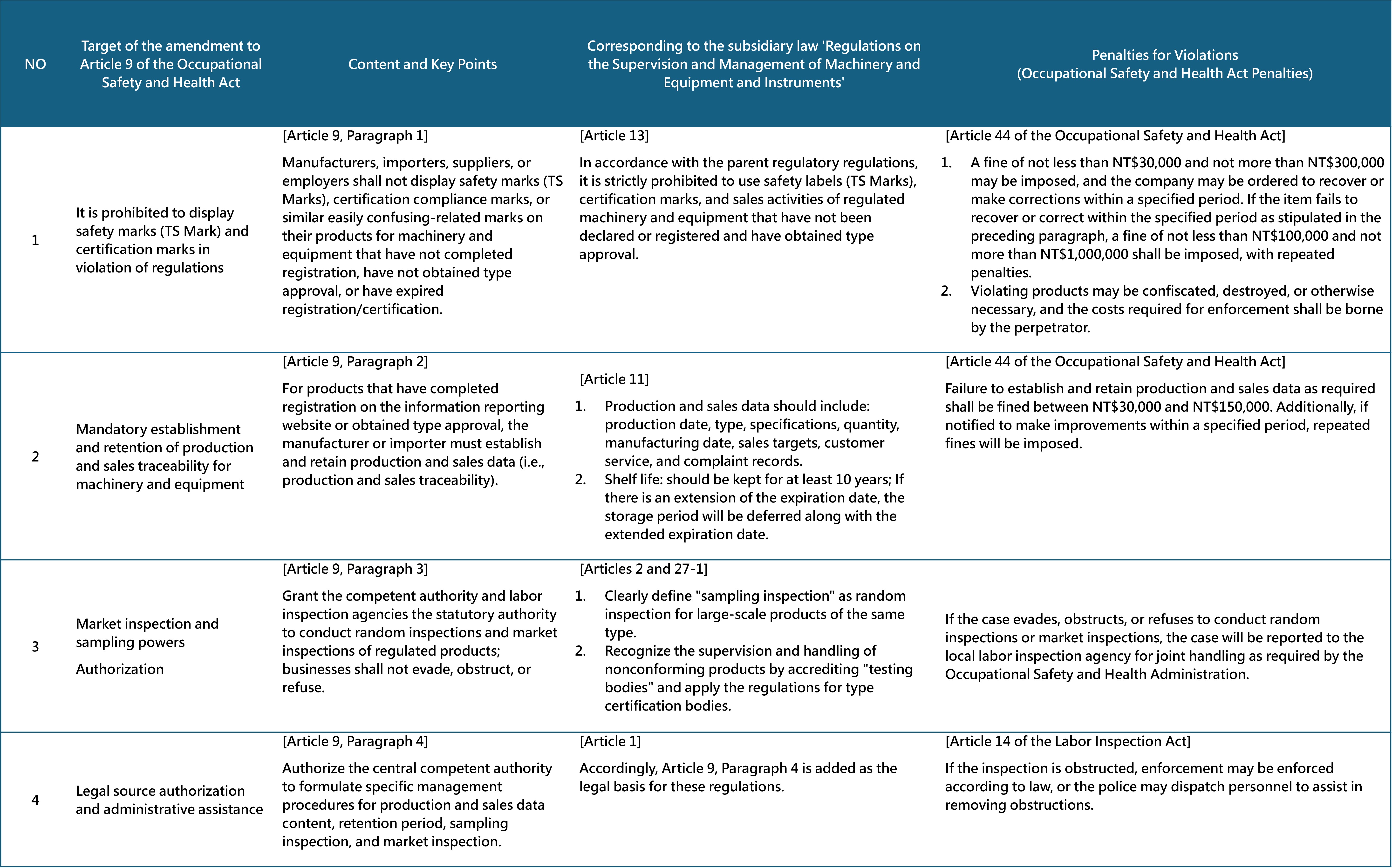
A consolidated review of the amendment to Article 9 shows that the former law already prohibited manufacturers and importers from using verification marks that could easily cause confusion. This amendment merely completes the coverage of items subject to Article 7 declaration and registration, and does not impose additional burdens on employers that purchase equipment as end users. The primary responsibility remains with source manufacturers and importers. The key points of the amendment are as follows:
1. Prohibition against improper display of safety marks (TS Mark)
The core purpose of Paragraph 1 of Article 9 is to prevent non-compliant products, or products whose inspection or verification certificates have expired, from misusing the safety mark (TS Mark) or verification mark, thereby strengthening source integrity management and protecting user safety. Manufacturers, importers, suppliers, or employers may not display the TS Mark, verification mark, or any similar mark likely to mislead consumers or business entities on products or packaging if the products have not completed safety information declaration registration, have not obtained type verification, or have expired certificates.
2. Establishment of traceable production-sales data
The revised Paragraph 2 of Article 9 requires manufacturers and importers to retain production-sales data. Pursuant to Article 11 of the declaration and registration regulations, such data must include production date, model specifications, quantity, factory shipment date, and sales customer information. This enables competent authorities to conduct forward tracking and reverse recalls when major safety defects are identified or when occupational accidents involve the same batch of machinery.
3. Improvement of downstream inspection and recall/removal mechanisms
Prior to the amendment, Article 9 applied only to machinery, equipment, and devices subject to type verification under Article 8. After the amendment, products that have completed declaration registration under Article 7 are also included within the scope of Article 9’s safety mark requirements and product supervision and market inspection. If market inspections identify products that fail to meet safety standards, the central competent authority may revoke the completion notice and require recall or removal within a prescribed period.
 |
Opportunity: The Relationship between Articles 7 and 9 of Taiwan’s Occupational Safety and Health Act and the EU's Digital Product Passport
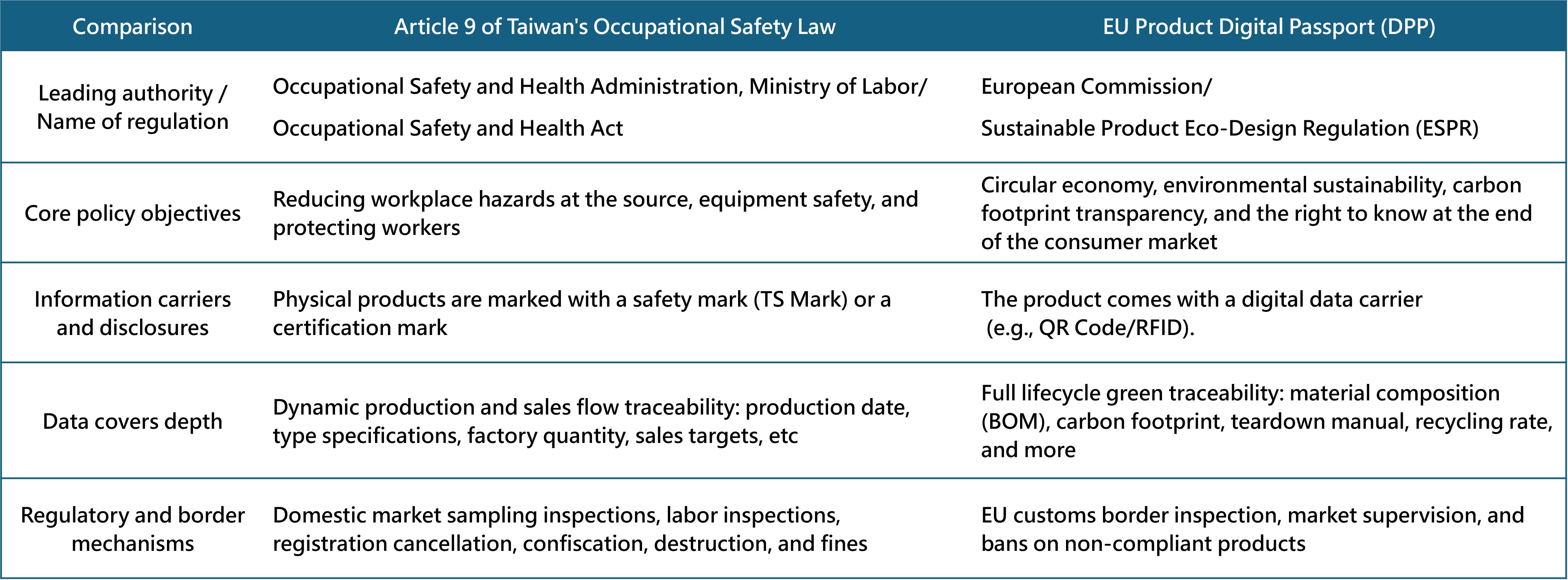
The amendments to Articles 7 and 9 concerning the control of safety marks (TS Mark), verification marks, and the establishment of production-sales data appear, on the surface, to be domestic legal measures aimed at improving the safety of machinery, equipment, and devices used in Taiwan’s workplaces. However, from the perspective of global supply chain trends, after the European Union formally promulgated the Ecodesign for Sustainable Products Regulation (ESPR) in 2024, the Digital Product Passport (DPP) became a key issue for global manufacturing and supply chains. The regulation requires products entering the EU market to carry a digital data carrier, such as a QR Code or RFID, to disclose detailed data throughout the product life cycle.
For Taiwan’s machine tool and machinery equipment companies, the safety mark and verification mark required under Article 9 are in strong alignment with the EU DPP requirement that products carry a digital data carrier. Companies may consider integrating Article 9 safety declaration and registration information directly into a product’s digital data carrier, allowing users to scan and access the relevant information while preserving both physical marks and digital passport data. In addition, the production-sales data required by Paragraph 2 of Article 9—including serial numbers, models, and sales recipients—constitute the basic nodes of the unique product identifiers and traceability data required by the EU DPP. What may appear to be an administrative cost for compliance with domestic occupational safety regulations can therefore become an opportunity for internal digital transformation. If companies build upon Article 9 production-sales data and further add carbon footprint, material recyclability, and other DPP-related information, they may be able to connect smoothly with the EU DPP framework and transform passive domestic compliance into a proactive opportunity to secure green orders in international markets.
 |
Conclusion and Recommendations
The amendment to Article 9 of the Occupational Safety and Health Act not only fills the legal gap in downstream inspection and market sampling following information declaration and registration, but also further strengthens source traceability for machinery, equipment, and devices in Taiwan through the preservation of production-sales data. From an international perspective, Article 9’s requirements for data authenticity and traceability resonate closely with the transformation trend represented by the EU Digital Product Passport. Therefore, the improvement of this provision should be viewed not merely as an enhancement of domestic occupational safety regulations, but also as an important turning point for Taiwan’s manufacturing industry to move toward digital management and align with international data governance systems. Companies that respond early and deploy digital production-sales traceability systems will be better positioned to enhance workplace safety while building core competitive advantages in global sustainable supply chains.
Based on the amendment to Article 9, Taiwan’s reinstatement of functional safety and electromagnetic compatibility (EMC) requirements for machine tools from January 1, 2027, the EU’s replacement of the Machinery Directive (2006/42/EC) with the Machinery Regulation ((EU) 2023/1230) from January 20, 2027, and the development of the EU Digital Product Passport, the following recommendations are proposed to help Taiwanese companies comply with domestic occupational safety requirements while further connecting with international standards and enhancing their competitiveness in global trade.
1. Introduce a one-machine-one-code digital production-sales traceability system
Companies may consider replacing traditional paper-based or fragmented electronic records by integrating statutory information such as production date, specifications, shipment quantity, and customer destinations into ERP or MES systems, while using serial numbers and QR Codes for machinery and equipment management. This can support inspections under Paragraph 2 of Article 9 and also lay the foundation for data connection with the EU DPP framework.
2. Review and confirm the validity of certificates
In response to Taiwan’s reinstatement of the latest functional safety and EMC requirements for lathes and machining centers, as well as the EU’s transition from the Machinery Directive to the Machinery Regulation, companies should comprehensively review and confirm the validity of existing product certificates and promptly upload necessary information to the machinery and equipment safety information platform established by the Ministry of Labor. This will help manage the transition between old and new certificates and avoid risks of interrupted market access.
3. Promote a dual-track framework integrating safety and sustainability
Relevant companies are advised to incorporate Article 9 requirements, modular disassembly of machinery and equipment, and low-carbon materials into the product design stage while establishing a unified digital data format. This will help companies meet Taiwan’s occupational safety requirements while also responding to global sustainability policy demands.


